Cold Fermented
Yeast & Fermentation
Why does lager taste so clean? It comes down to the yeast. Tennent's and WEST both ferment with bottom-fermenting yeast, which works at the base of the tank and, at low temperatures—roughly around ten degrees Celsius—produces few fruity aromas. Ales, by contrast, ferment with top-fermenting yeast at noticeably warmer temperatures, around 18 to 22 degrees, often tasting fruitier. This very difference separates the two great beer families, lager and ale.
Lager yeast, Saccharomyces pastorianus, is a hybrid of two yeast species. In 1883, the Danish researcher Emil Christian Hansen isolated the first pure culture of bottom-fermenting yeast at the Carlsberg laboratory in Copenhagen. Two years later, in 1885, Hugh Tennent brought lager brewing to Glasgow.
After primary fermentation comes conditioning, or lagering—and that's where the beer gets its name: lager simply means 'storage beer' in German. The beer rests cold in tanks, the yeast settles out, and the rough edges of young beer soften. How long this takes at Tennent's, the brewery doesn't say.
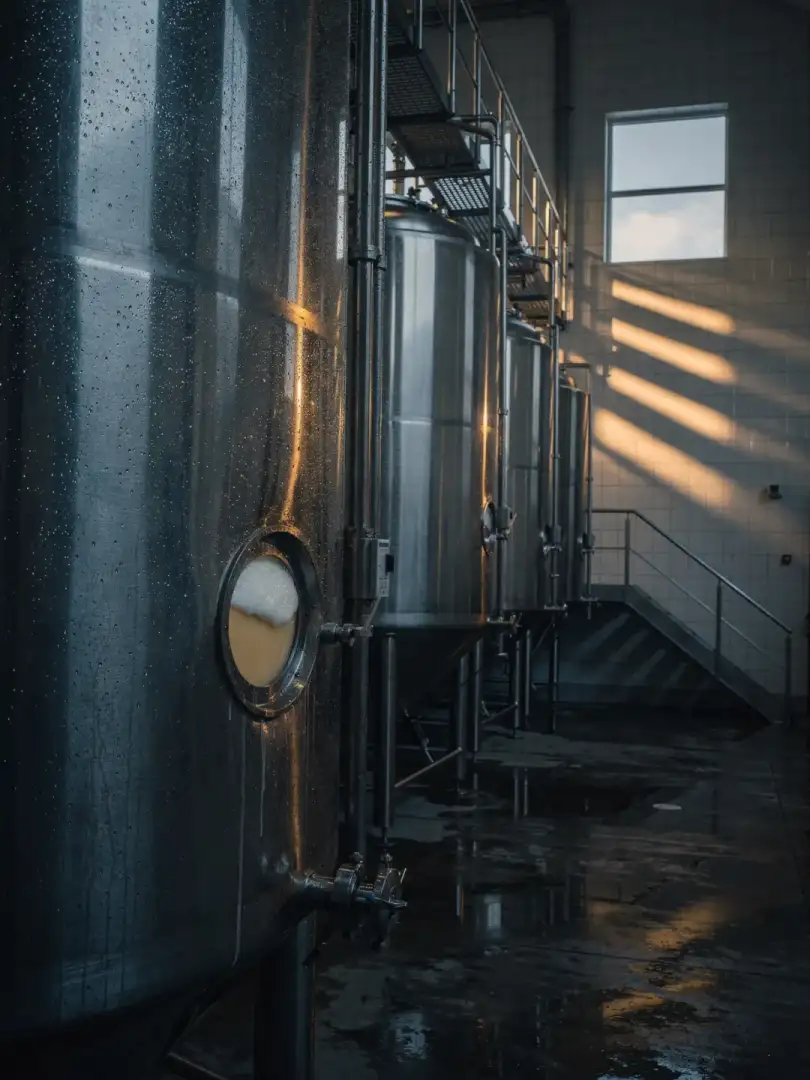
Today, fermentation and conditioning take place in large, closed stainless steel tanks, where temperature and pressure can be precisely controlled.
One difference from Scottish ale is time. Ales are often drinkable within days, while lager takes weeks. That's the price for the calm, clean taste Hugh Tennent was after in 1885. Anyone used to ale notices the difference immediately: less fruit, fewer esters, but more clarity and a finish that wraps up quickly.