From Afar
Hops
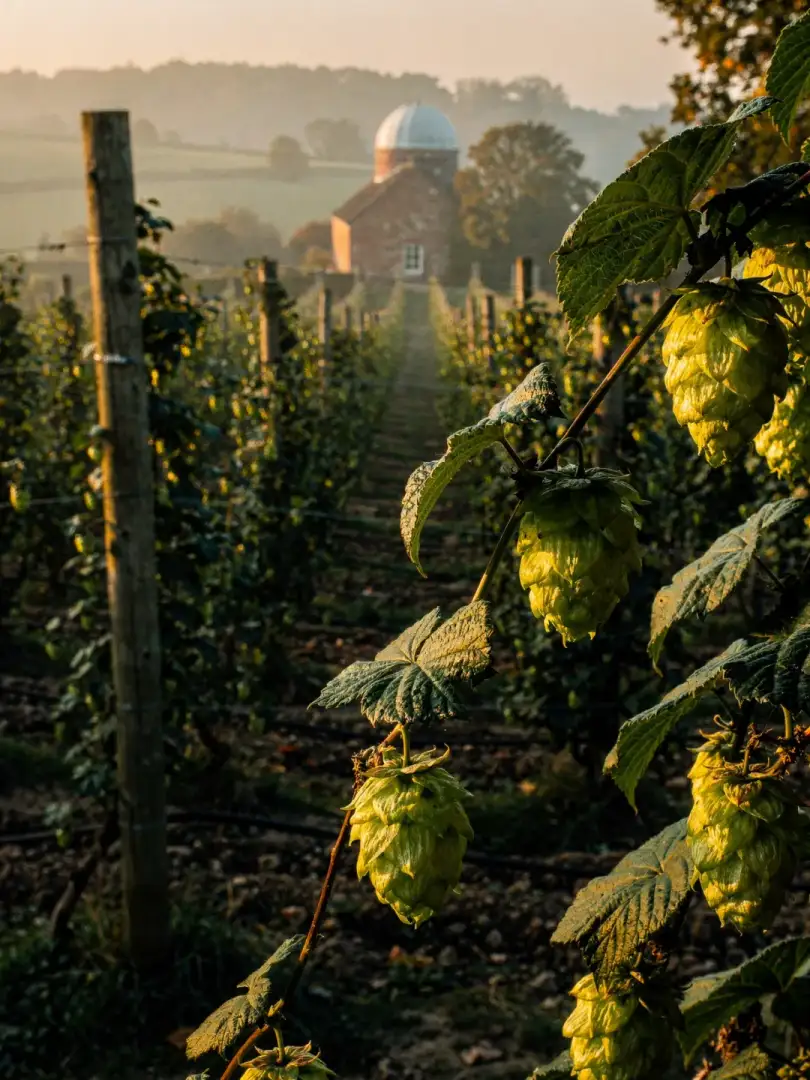
No hops grow in Glasgow, and that's never been any different. The breweries source theirs from growing regions in England, Germany, or the Czech Republic. In Britain, hop gardens are concentrated in Kent, Herefordshire, and Worcestershire, and every English brewer knows the names Fuggle and East Kent Goldings.
Tennent's doesn't publicly disclose which varieties it uses. For a Pilsner-style pale lager, classic choices would be varieties from Žatec in the Czech Republic or the Hallertau in Germany, such as Saaz or Hallertauer Mittelfrüh. For WEST's Reinheitsgebot beer, German hops are the obvious choice.
Hops serve two purposes. Boiled early, they release bitterness that balances the sugar in the wort. Added late, they contribute aroma—floral, herbal, or citrus notes. Bitterness is measured in IBU, International Bitterness Units, a scale that starts around 10 and exceeds 60 for bold IPAs.
A Munich-style Helles, according to the BJCP guidelines, sits at 16 to 22 IBU, an international pale lager at 18 to 25. That's mild, and that's exactly how these beers are meant to taste: the hops hold back, and the malt leads.
Scottish Heavy, the Scottish counterpart, is even more restrained at 10 to 20 IBU. Taste a Glasgow beer, and you'll notice malt and freshness rather than hop bite. An IPA built for hop impact is the exception here, not the rule, and the city's major brands deliberately favour balance over force.