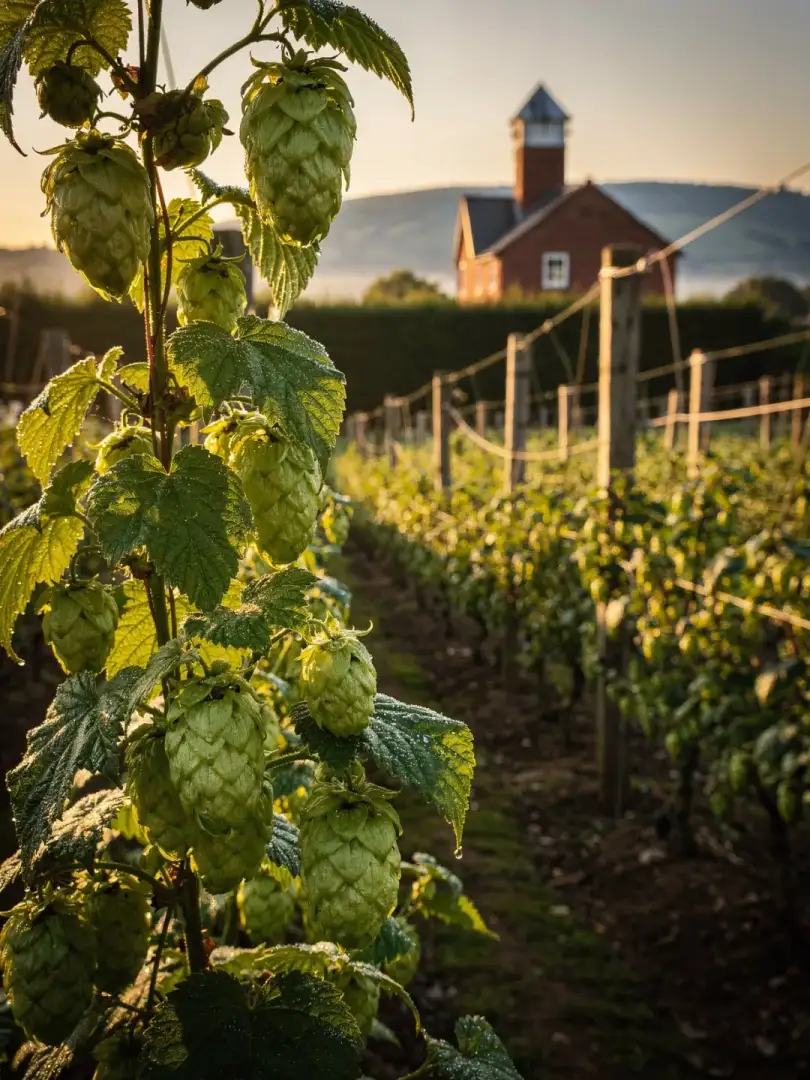
Fuggle and Goldings
Hops
Why is Fuggle hop considered typical for the West Midlands? The variety traces back to Richard Fuggle, who propagated it in 1875. When it was offered to growers in Worcestershire in 1884, it was still called Fuggles Noted Golding. It brings earthy, woody, and slightly floral notes to beer, without being loud.
The other classic English variety is the Golding. Various Golding types can be traced back to the 1790s. The name East Kent Goldings is a protected designation of origin, and it belongs to Kent. In Herefordshire and Worcestershire, hop growers simply speak of Goldings.
Hops grow on tall frames, up which the bines twine themselves on strings in spring. In September they are cut and brought for drying. This was done in hop kilns, called oast houses in England, where hot air passed through the cones. Many stand empty today or have been converted into homes.
How much hops grow today in Herefordshire and Worcestershire is far less than around 1894, when the area reached more than 10,000 acres. Current figures aren't documented, but the varieties persist, and small breweries advertise regional hops from their immediate neighborhood.
Hops provide two things: bitterness and aroma. The bitterness comes from alpha acids released during long boiling. The aroma evaporates if boiled too early, so aromatic hops go into the kettle late. A bitter has, by the standard, 25 to 40 bitterness units, and this exact range makes it drinkable rather than harshly sharp.