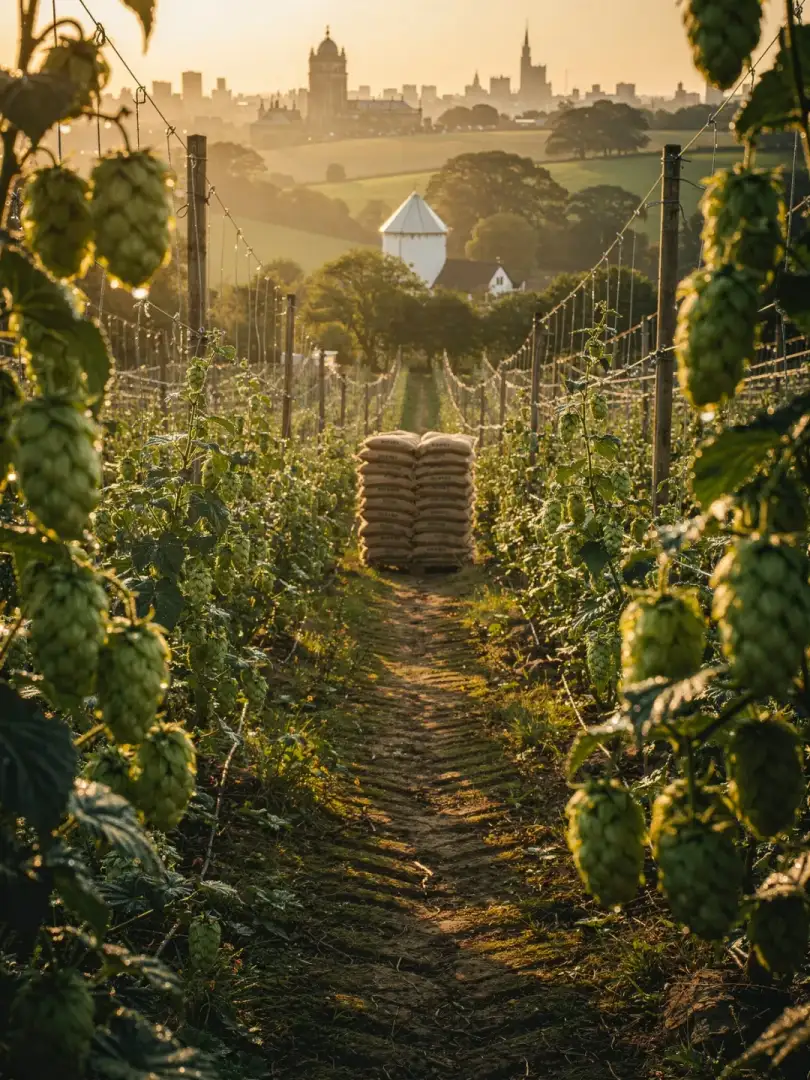
Market, Not Garden
Hops
No hops grow in London, but they were traded here. The city's brewers bought their hops from Kent and Surrey. The market for this trade was in Southwark, near London Bridge. The Hop Exchange on Southwark Street, built in the 1860s, was the trading house for hop merchants. Today the building serves as office space.
Two varieties define the English profile. "Fuggles" and "Goldings" are considered the classic varieties of the region, with aromas running toward earth, wood, and mild spice. East Kent Goldings even hold a Protected Designation of Origin (PDO, 2013). How a London bitter tastes with these hops depends more on the blend than on any single variety.
Bitterness and aroma are two different things. Bitterness comes from the alpha acids that transfer from the hops into the wort during boiling. It's measured in IBU, a unit for bittering units. Aroma comes from essential oils that evaporate during boiling and are therefore often added late in the boil or during cold conditioning. This is called "dry hopping."
A Best Bitter following the BJCP guidelines measures 25 to 40 IBU, while an English IPA runs 40 to 60. The English IPA also has London roots: the brewer Hodgson at the Bow Brewery in the city's east supplied the East India Company with pale, heavily hopped export beer, though he didn't invent a new style in doing so.
The city's young breweries often reach for American varieties. Along the Bermondsey Beer Mile, hops from overseas end up in the glass, smelling of citrus and berries, and the contrast with mild English tradition is entirely intentional.