Roasted Barley
Malt & Grain
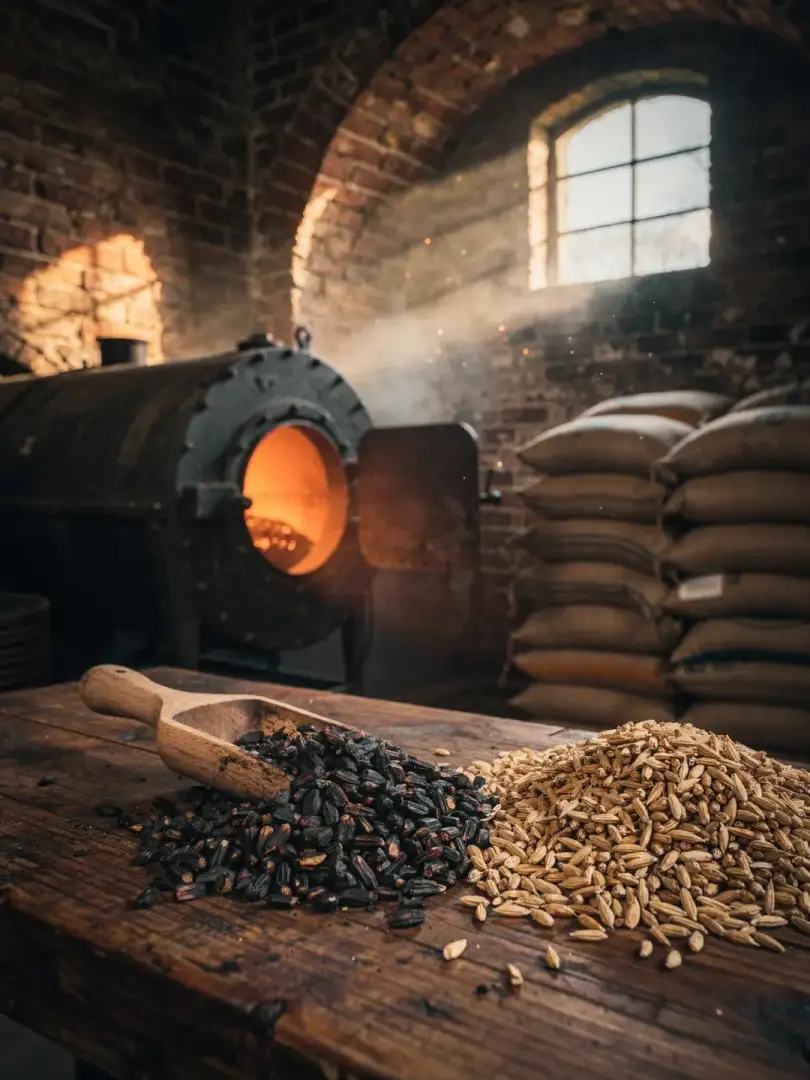
The black in the glass comes down to a single step: roasting barley. According to Guinness, this happens at 232 degrees Celsius, and this roasting gives the stout its color, its coffee aroma, and the dry, slightly bitter note you taste before anything else registers.
This makes barley the backbone of Irish stout. The base is pale malt, which is germinated at the maltings and then kilned, meaning dried with hot air. To this is added roasted barley, which, as commonly described, is unmalted and therefore tastes especially sharp and smoky.
How much of each goes into a given brew is something Guinness doesn't reveal either. Still, anyone holding a Guinness Draught is drinking a beer made almost entirely from barley. Only the general direction is known: the more roasted barley, the darker the beer, the drier the finish.
Unlike the chocolate or coffee malt used in other dark beers, which tends to taste sweet and round, roasted barley is sharp. This explains why Irish stout stays so lean despite its color: it has little residual sugar, and the roasting takes on the role that sweetness plays elsewhere.
The site at St James's Gate already had two malthouses back in 1759, so malting was part of the operation from the very start. The result today falls within a tight range. The style standard for Irish stout calls for original gravities of 9 to 11 degrees Plato, meaning relatively light beers, and colors between 49 and 79 EBC. The EBC color value measures how dark a wort is. Anything over 49 already counts as deep brown to black.