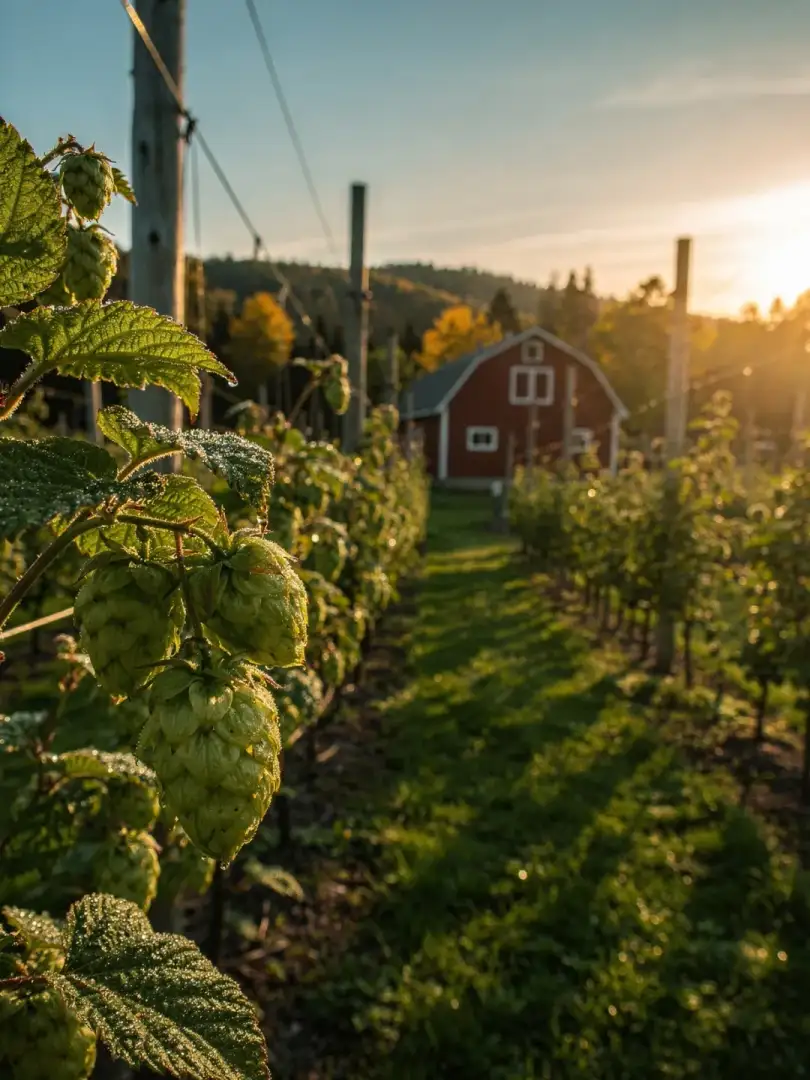
A Young Crop
Hops
Hop growing is a young venture in Québec. Around 2009, there were an estimated ten farms at most growing hops. By 2021, 41 farms had registered with the province's agriculture ministry (MAPAQ) as hop producers. That's a small number compared with the many breweries that need hops.
Hops are the seasoning of beer. Their cones contain bittering compounds that give beer its sharp bite and help preserve it, along with essential oils that smell of flowers, citrus, or herbs. Boil hops early and you get bitterness. Add them late, or dry-hop, and you get aroma. Dry-hopping means adding hops to the beer after fermentation, so the oils don't boil away.
An estimated one hundred or so hop varieties find their way into Québec's beers. For the province's own farms, the Association des Microbrasseries du Québec compiled a 2021 catalog of locally grown varieties, so brewers know what the province can supply.
In Belgian-style beers, hops tend to sit in the background. A tripel like Unibroue's La Fin du Monde falls within the style guideline of 20 to 40 IBU (the measure of bitterness), while an imperial stout like Dieu du Ciel!'s Péché Mortel can go considerably higher, at 50 to 90 IBU. Both beers lean on malt and yeast, with hops providing the counterweight.
Before hops, New France brewed with spruce tips. This spruce beer, bière d'épinette, was believed at the time to ward off scurvy. Whether that was actually true is hard to say today, but the legend persists.