Gypsum & Earth Cellars
Water & Soil
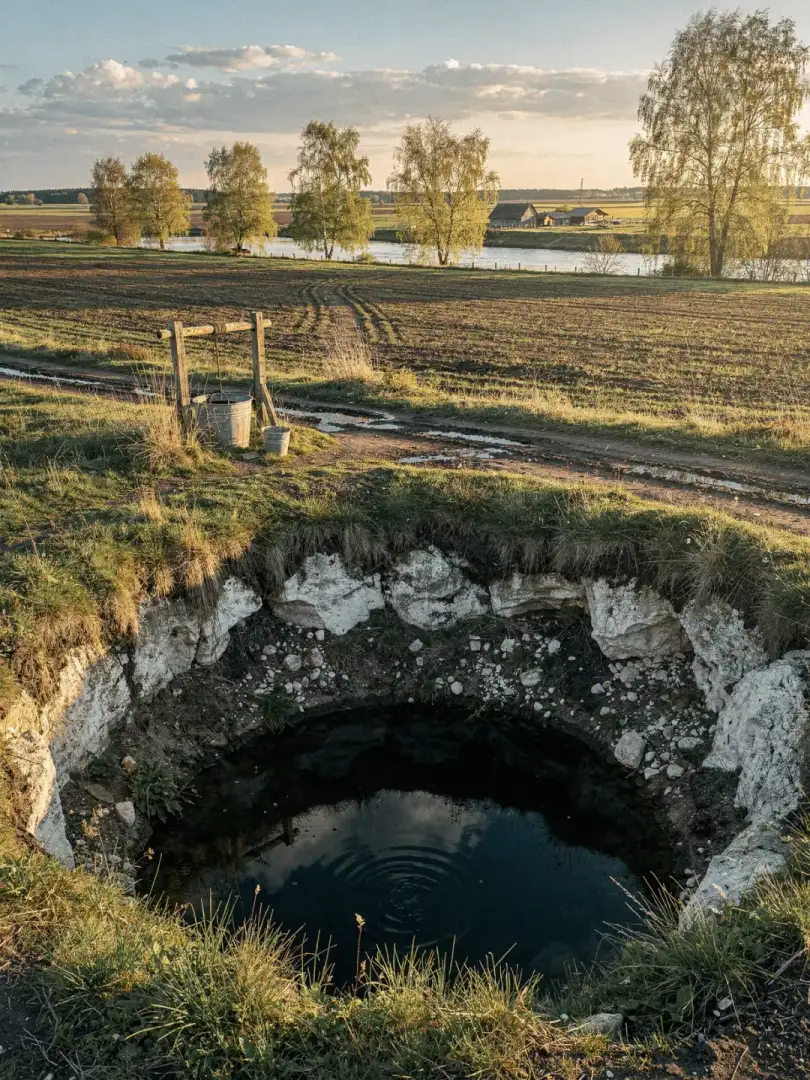
Around Biržai, the ground is riddled with holes. Groundwater dissolves gypsum, dolomite, and other soluble rock there, causing the subsoil to subside and forming sinkholes that Lithuanians call 'smegduobės.' The country's largest karst sinkhole is called Karvės ola, the Cow Cave, and is a stop on every tour of the town.
According to local tradition, the people of Biržai have long made use of these mineral-rich resources, including for healing purposes. Which wells and springs individual brewers tap into is rarely shared. As a general rule: water from gypsum-rich subsoil contains a lot of sulfate, and sulfate sharpens the perception of bitterness and dryness in beer. That's a property of such waters, though not a fixed rule for Kaimiškas.
More important than any hardness figure here is the cold. Without refrigeration, farmhouse brewers had to get their supplies through the summer, especially the yeast. Brewer Aldona Udrienė from Jovarai says her ancestor buried the yeast about 1.2 meters deep in the earth during winter. In summer, it was stored on river ice, covered with straw and sawdust and topped with sand.
The landscape fits this practice well. Northern Lithuania is flat to gently hilly, winters are long and cold, and the ground stays cool at depth year-round. A hole in the earth or a cellar beneath the house replaced any cooling system, keeping beer and yeast within reach without spoiling.
Visitors to Biržai or Pasvalys won't find this history in the glass, but in the landscape itself: the sinkholes, the rivers, and the cold cellars are as much a part of farmhouse beer as the malt.