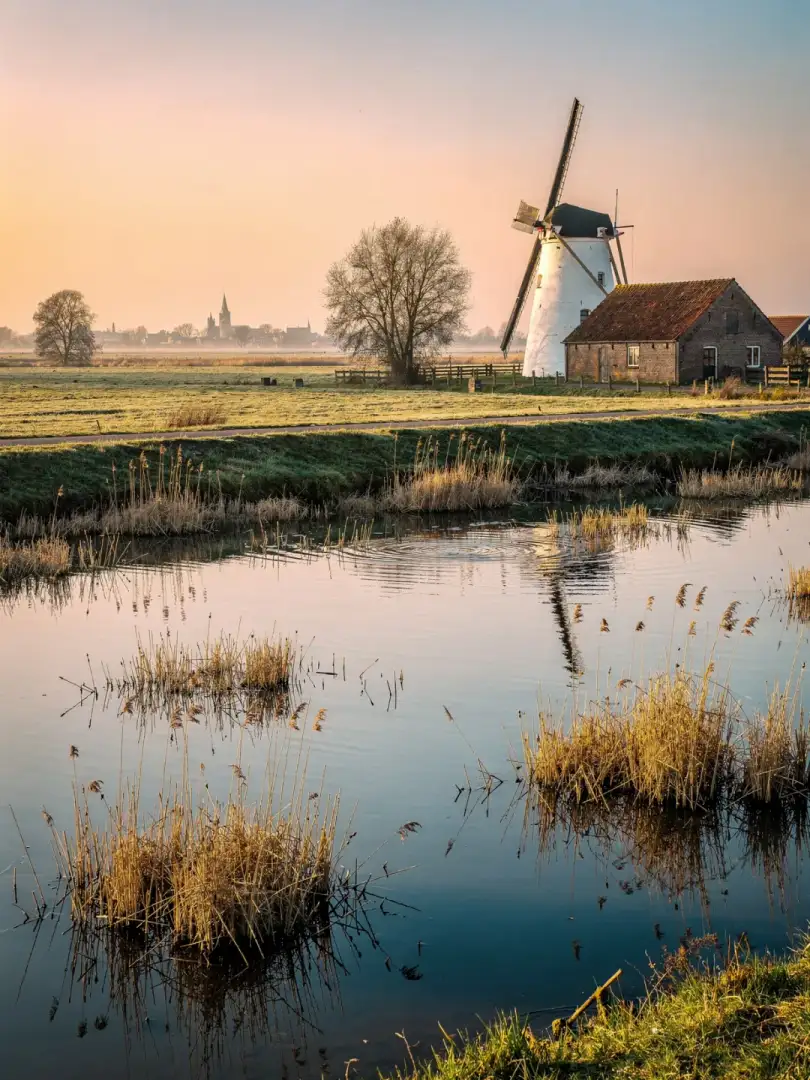
Canals, Polders, Windmills
Water & Soil
Where does brewing water come from in a country largely below sea level? From the tap, just like almost everywhere else. Modern breweries treat their water regardless: they strip out minerals or add them back in until the water suits the style they want. The old idea that water alone defines a style held true for Pilsen or Burton, but in today's Amsterdam, that's history.
Holland's soil tells you more about its beer than its water does. The land is built from marsh, polder, and peat, and much of it once sat right at the groundwater line. There are no cool cellars here like the ones found in Franconia for lagering beer. Nobody wanted to drink from the ditches and canals either, since the water was contaminated. So people brewed and drank beer instead, and did so in large quantities from early on.
Water also came down to location. Haarlem and Amsterdam sit on waterways that brought raw materials in and shipped barrels out. That turned a local beer into an export beer.
In Amsterdam-Oost, Brouwerij 't IJ occupies a former municipal bathhouse called Funen. That's not just a quirky story, it's the actual reason brewer Kaspar Peterson chose the building in 1985: it had a water connection, drainage, easy-to-clean tiles, and a steam generator. Right next door turns the De Gooyer windmill, built in 1725.
What this means for flavor: Holland brews without any grand tale of rock and spring water. Its breweries work with treated water, and the result is a clean, neutral canvas where malt, hops, and yeast take the leading roles. The real character lies in the technique and the yeast, and that's what the next stops are about.