Rolling Hills and Cellars
Water & Soil
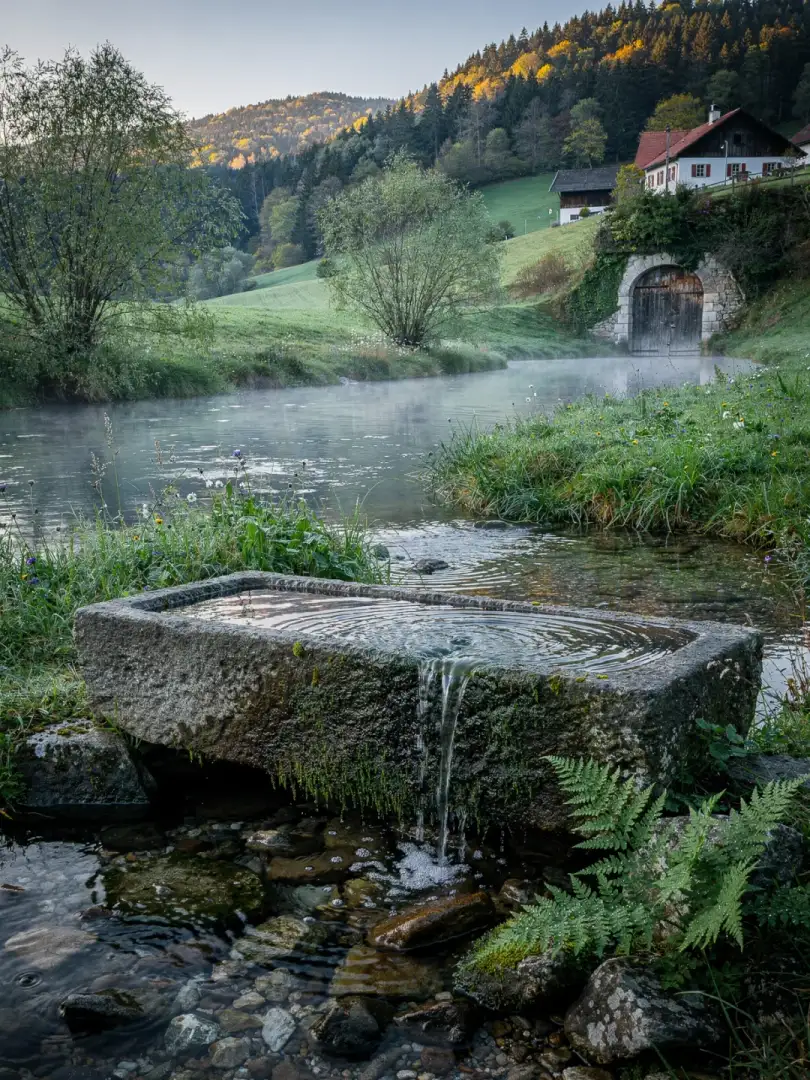
The Innviertel likes to call itself the Quellenviertel (“Spring District”), a fitting name for a landscape of gentle hills, moorland and stream valleys between the Inn and Hausruck. The soil is composed mainly of Schlier, a fine-grained marine sediment from the Alpine foothills, and gravel left behind by the rivers. Both filter rainwater before it resurfaces as spring or well water, as seen around Ried im Innkreis or Schärding.
What matters to the brewer is how hard this water is. Hardness refers to dissolved minerals, chiefly calcium carbonate. Soft water lets hop bitterness come through gently and suits pale beers, while higher carbonate levels reduce the acidity of the mash and better balance darker malts. This chapter doesn't list specific hardness levels for individual breweries, as these vary from well to well and are treated differently by each brewery.
More important than a number is what the brewers do with it. Brewing water is used in the mash tun, but also for rinsing, cooling and cleaning. A brewery that draws its own well water or sources it locally knows its fluctuations and compensates for them through mashing technique.
The second half of water and terroir lies underground. In this hilly landscape, beer cellars could once be dug into the hillside with little effort, staying cool in summer. The fact that beer was aged there for long periods is the reason the Bavarian Brewing Order of 1553 restricted brewing to the period between Michaelmas (September 29) and St. George's Day (April 23): summer was too warm for safe fermentation. Since the Innviertel belonged to Bavaria at the time, the rule applied here too.