Granite & Springs
Water & Soil
Why does Mühlviertel beer taste so round and mellow? Part of the answer lies beneath the fields. The districts of Rohrbach and Freistadt belong to the southwestern part of the granite plateau of the Bohemian Massif, an ancient, hard bedrock.
Rain seeps through granite only slowly and dissolves hardly any minerals as it goes. The spring water in the area is therefore soft, and the region even markets itself with the phrase "primeval rock water." Soft water lets the bittering compounds of the hops come through clean and fine, rather than making them feel harsh.
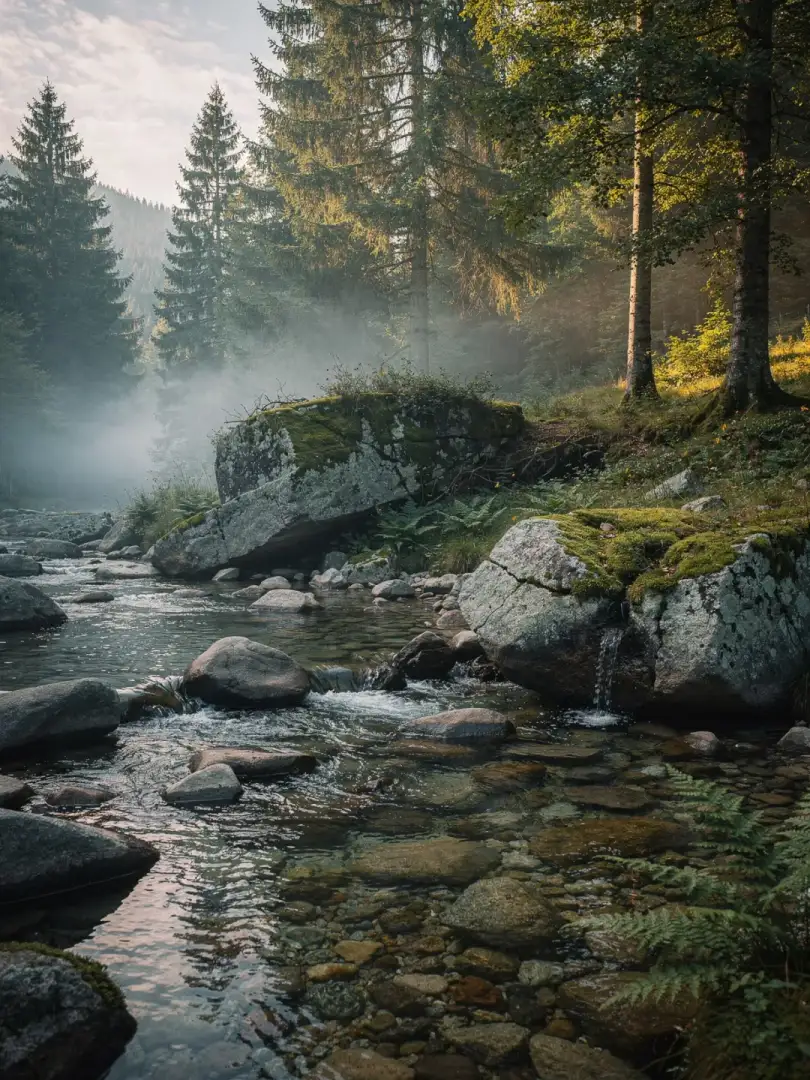
The landscape is rugged. Forests, granite boulders, and gentle hills define the land, crossed by streams like the Große Mühl and the Kleine Mühl, which give the region its name (Mühlviertel, meaning "mill quarter"). Freistadt itself sits on the Feldaist, close to the Czech border.
In Hofstetten, granite even shapes the brewing process itself. There, the Granitbock is caramelized using red-hot granite stones and fermented in old granite troughs. Here the stone serves as both foundation and tool in the brewhouse, lending the beer a lightly roasted caramel note.
One point of context is important: today, almost all breweries treat their water, using filters, softening, or added salts. Water from granite bedrock is a good starting point, but the brewmaster adjusts it anew for each beer. The idea that the soil alone shapes the style is really a picture from an earlier time.
The cool climate of the region helps too. At elevations of 350 to 650 meters, summers are milder than in the Danube valley, and the cellars stay naturally cold. That was a big advantage for lagering bottom-fermented beers long before refrigeration existed.