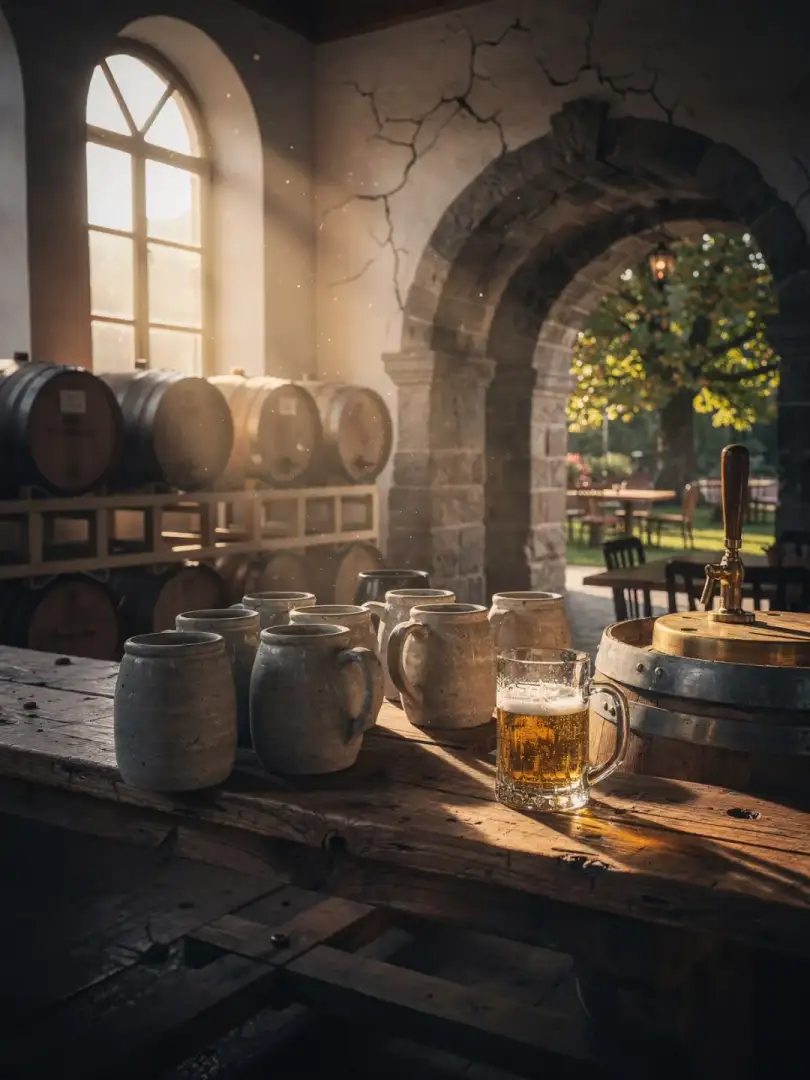
Krügerl, Seidel, Stone Mug
Tasting
In the glass, Salzburg pilsner appears pale, with a white head and an aroma of grass, bread crust, and hop blossom. The first sip is fresh, the body lean, and a dry, short-lived bitterness lingers at the finish.
Trumer Pils from Obertrum represents this style, while Stiegl-Goldbräu from Maxglan represents the city brewery's take. Neither reveals its recipe in detail; for comparison, it's worth checking the label for alcohol content and original gravity. The Märzen from the Augustiner Bräustübl in Mülln offers a third example: maltier, fuller, with a soft carbonation.
In Austria, beer is ordered by size. The Krügerl holds half a liter, the Seidel 0.3 liters, the Pfiff 0.2 liters. At the Bräustübl, however, the stone mug is the classic vessel: it keeps the beer cool for longer and keeps the head from collapsing too quickly.
The ideal serving temperature for a pilsner is cool but not ice-cold, since excessive cold numbs the hop aromas. A Märzen can be served a touch warmer, letting the malt aromas come through.
Anyone ordering a beer in Mülln should bring some patience. At the Bräustübl, the beer is drawn from wooden casks into stone mugs. The head should be fine-pored and shouldn't spill over the rim of the glass. A good pilsner takes time to pour properly, since the crown builds up gradually. A clean, cold-rinsed glass is essential, too—any trace of grease will collapse the head instantly.