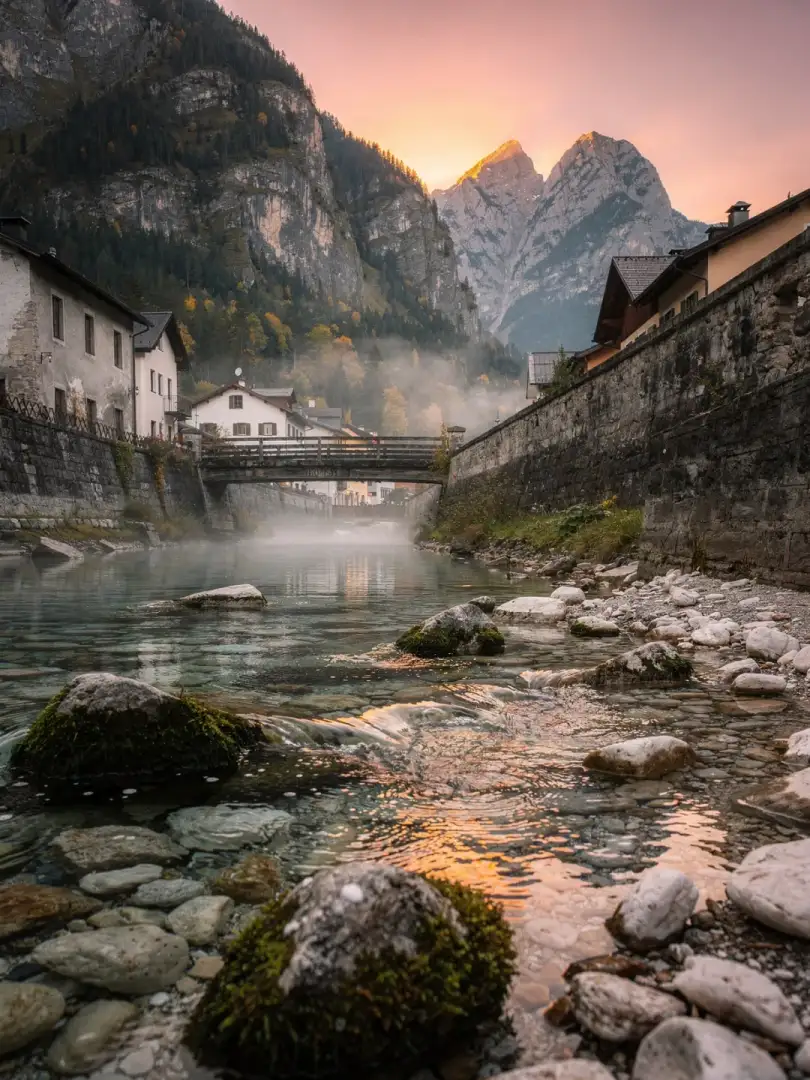
Untersberg and the Almkanal
Water & Soil
According to the brewery, Stiegl's brewing water comes from a deep well at the foot of the Untersberg, the limestone massif that rises south of the city. It's used untreated. How hard water is depends on the rock it flows through, and minerals dissolve more readily in limestone than in primeval bedrock.
It wasn't always this way. Water used to be drawn right from the middle of town: from the brewhouse, the Stieglein—a public staircase—led down to the Almkanal. This canal is an old water-supply system that has carried water into the old town since the Middle Ages, and for brewers and millers alike it was a lifeline.
What does water do to beer? Lime-rich water raises the acidity during mashing—that is, the pH value—and this dampens pale malts. Dark malts compensate for this, which is exactly why water and beer style are so closely linked. A pale, finely hopped pilsner calls for softer water than a robust, malty Märzen.
In Kaltenhausen near Hallein, nature itself serves as a refrigerator. Cold air streams out of the ground beneath the scree of the Barmsteine, and these so-called wind holes gave the place its name. For a brewery that had no refrigeration machinery, this was a clear locational advantage.
Obertrum am See lies in the Salzburg Lake District, a hilly landscape dotted with moraine lakes north of the city. Amid meadows and water, a pilsner matures here unhurried, with patience built into the process. The coolness of the lakes and the proximity of the Alps shape the climate for both lagering and fermentation.