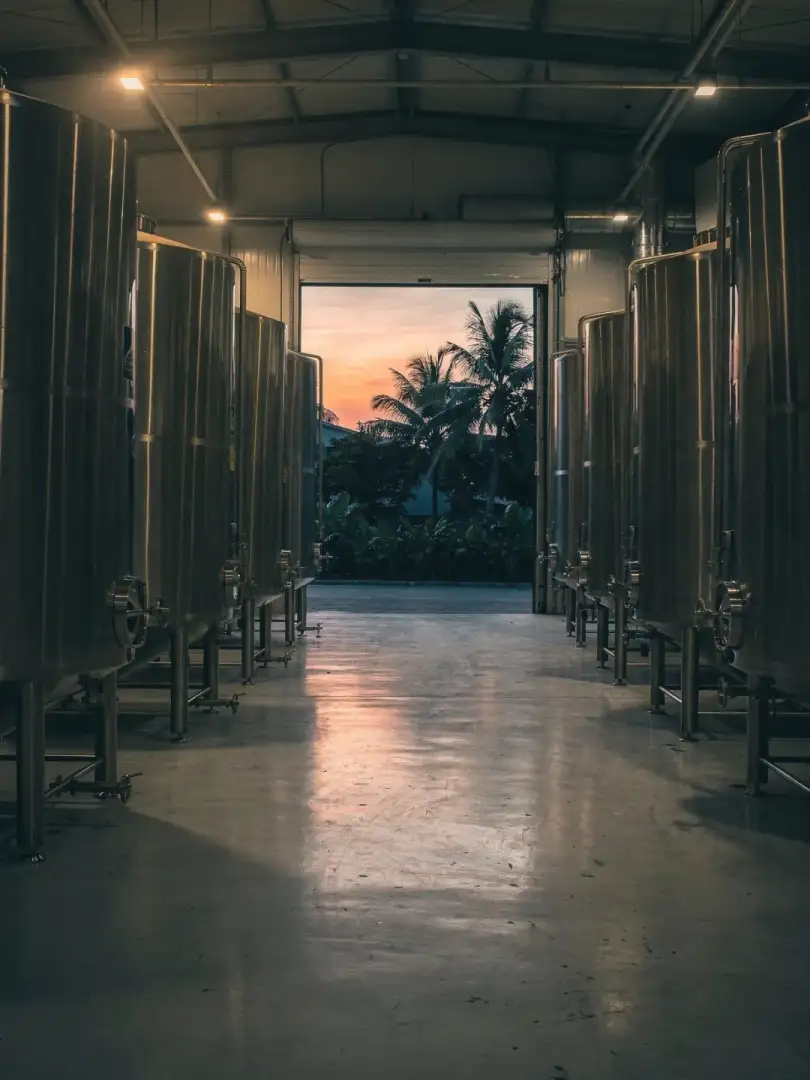
Lager Yeast Under Refrigeration
Yeast & Fermentation
Is San Miguel a bottom-fermented beer? Yes — Pale Pilsen is a lager, fermented with bottom-fermenting yeast. This yeast works at cool temperatures, usually around 10°C (50°F), and settles at the bottom of the tank once fermentation finishes. In Manila, that alone is an achievement, given the roughly 30°C (86°F) outside.
Lager yeast is actually a hybrid: Saccharomyces pastorianus arose from the brewer's yeast Saccharomyces cerevisiae and a wild species, Saccharomyces eubayanus, first described in Patagonia in 2011. When the Dane Emil Christian Hansen achieved the first pure culture of a bottom-fermenting yeast in Copenhagen in 1883, lager beer became predictable worldwide.
That predictability was exactly what a brewery in the tropics needed. A pure, consistent yeast strain delivers the same beer batch after batch, and refrigeration keeps fermentation within the range where it runs cleanly. German brewmasters of the 19th century brought this knowledge with them — in Manila's case, it was Ludwig Kiene.
After primary fermentation, which takes a few days, the beer matures in the lagering tank at temperatures near freezing. Brewers call this "lagering" — hence the name lager. During this time, haze particles and yeast residue settle out, and the beer loses its green, unfinished notes. The brewery doesn't disclose how long each brand is lagered.
Filtering follows almost without exception. A beer sitting on a shelf in the heat has to stay stable, or it will turn hazy and spoil. That's why Manila's beer, too, comes out bright and clear rather than cloudy like an unfiltered cellar beer.