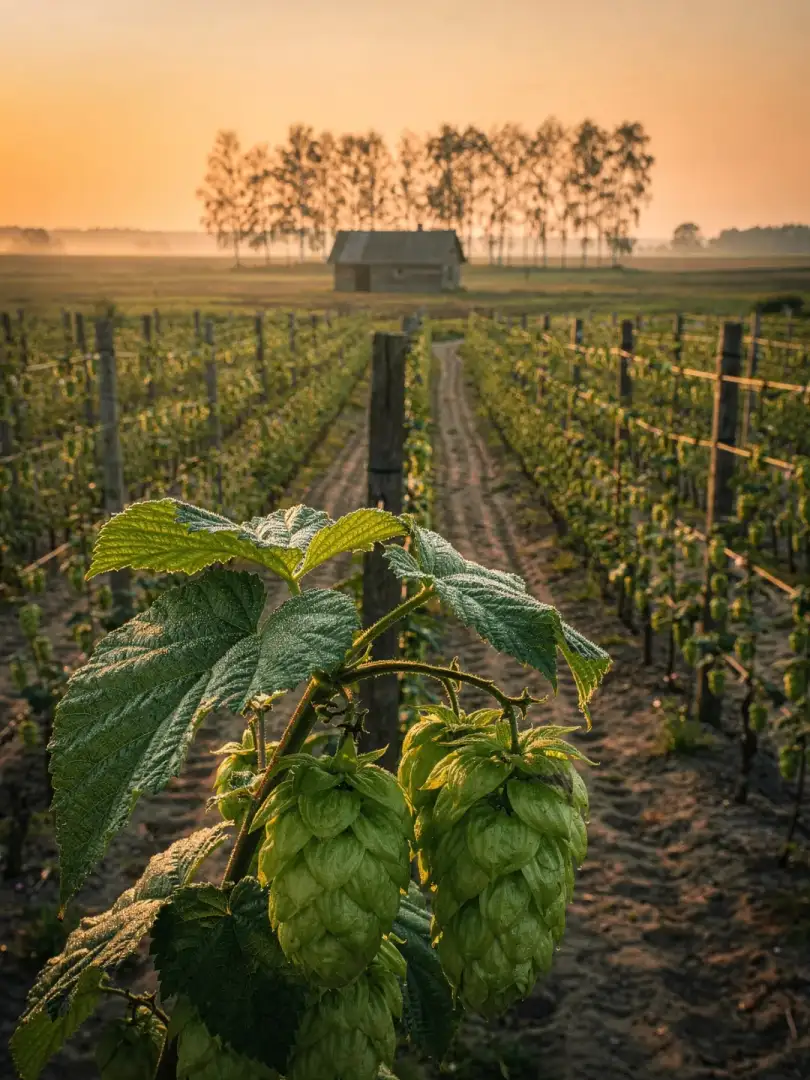
Tomyski and Lubelski
Hops
What hops go into Grodziskie? According to the Grodzisk brewery, an aromatic Lubelski variety, named after the region around Lublin in eastern Poland. Historically, however, it was a hop native to Wielkopolska itself—the Nowotomyski or Tomyski, grown around Nowy Tomyśl in Greater Poland.
Hops provide both bitterness and aroma. Bitterness comes from alpha acids, which only become soluble in the wort after a long boil. Aroma comes from volatile oils that evaporate if the hops are added to the kettle too early. That's why hop additions are split.
According to historical accounts, the wort was boiled for 90 to 120 minutes. The larger hop addition went into the kettle after about fifteen minutes, with the smaller addition following roughly half an hour before the end of the boil. This produced just enough bitterness to balance the smoke and the slight sweetness of the wheat.
The style's range runs from 20 to 35 bitterness units, known as IBU. That's moderately bitter, ranging from mild to about as bitter as a German Pils. What matters is the dry finish rather than sharpness, since the beer should stay light and refreshing without overpowering the wheat malt.
The craft beer scene has brought other Polish varieties into the glass. The Grodzisk brewery uses Marynka, Magnum and Cascade, among others, in a paler pale ale. In the Grodziskie itself, though, hops remain a supporting player to the smoke—the opposite of a boldly hopped IPA. Here, no one wants hop fruitiness; the smoke takes center stage.