Harbor and Hansa
Region & History
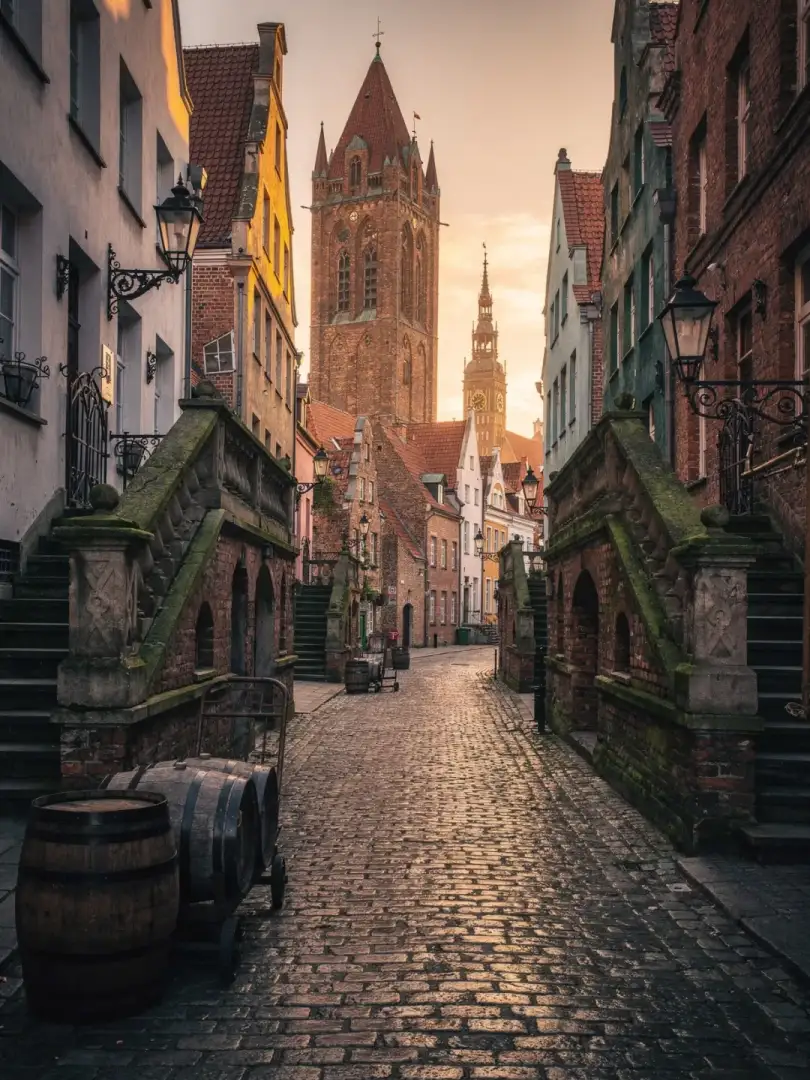
What is Jopenbier? It was a very strong, thick beer from Gdańsk, brewed in the Hanseatic city since the 14th century and shipped across the Baltic Sea. Gdańsk, German Danzig, lies at the mouth of the Vistula (Wisła) where it meets the sea. This location made the city a hub for grain, timber, and beer.
Records cite around 56 breweries in the city during the 14th century. Today's ulica Piwna, German for Bierstraße (Beer Street), is a reminder of this: before 1945 it was called Jopengasse, named after the Jopen or Schopen brewers who lived there. After the war, the name was translated literally into Polish.
Jopenbier was considered extremely full-bodied. Descriptions speak of an extract up to 55 degrees, meaning the dissolved substances from the malt present in the wort before fermentation. A regular Pilsner starts at around 12. Because of its high sugar and alcohol content, the beer kept well and was suited for export, though it behaved more like syrup than a thirst-quenching drink.
Over the centuries, Gdańsk changed hands between states several times. From 1920 to 1939 it was a Free City under the protection of the League of Nations, and after 1945 it became part of Poland. Jopenbier disappeared during this period, and the old brewing tradition was broken. When the Gdańsk brewery in the Wrzeszcz district collapsed in the early 1990s, farmer Andrzej Przybyło built up Browar Amber in Bielkówko, brewing its first batch, according to the brewery, on November 24, 1994.
Jopenbier only made a comeback a few years ago: the Olimp brewery from Toruń recreated it in 2018, followed by Gdańsk's PG4 brewery in 2019. Alongside it stands the Baltic Porter, now considered the house style of Polish coastal brewers. Neither Jopenbier nor Porter holds EU protected origin status—Porter is purely a style designation.