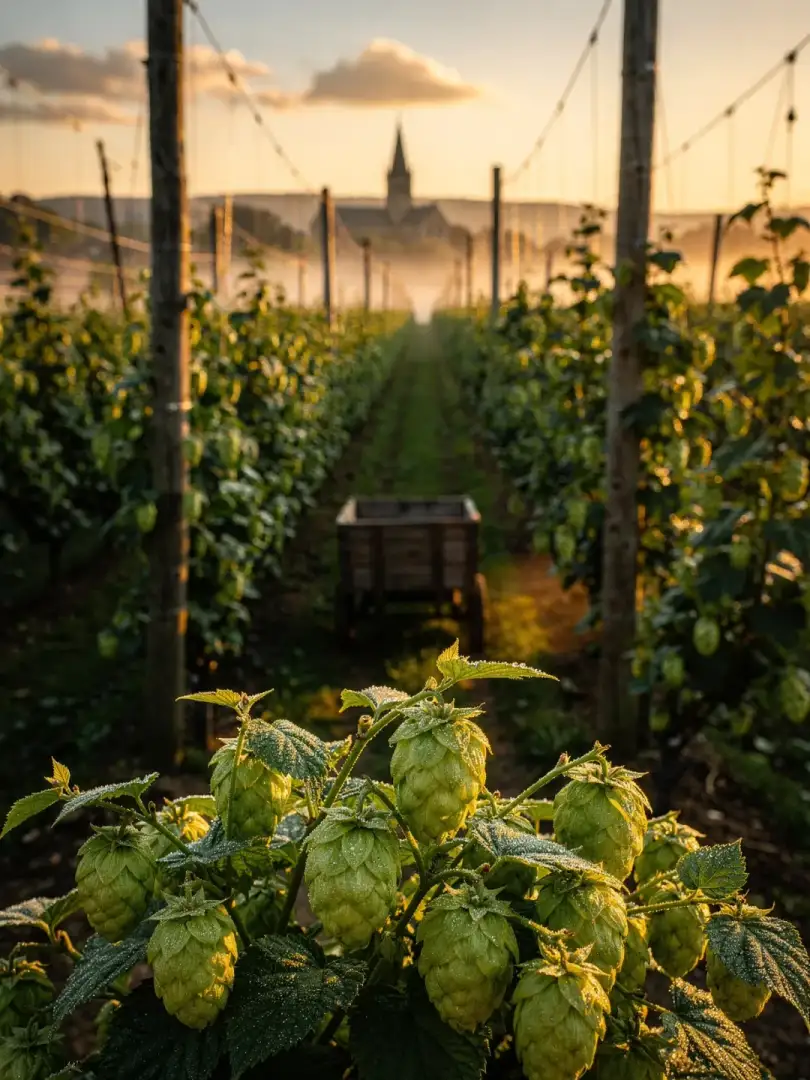
Perle from Bavaria
Hops
Hop fields aren't an image you'd associate with Galicia. According to the manufacturer, the hops for Estrella Galicia come from elsewhere. For the 1906 Reserva Especial, the variety named is Perle from the Hallertau. The Hallertau region in Bavaria, at around 17,129 hectares, is the largest contiguous hop-growing area in the world, accounting for about 83 percent of Germany's total hop acreage.
Hops give beer two things: bitterness and aroma. The bitterness comes from alpha acids, which only become soluble once the wort is boiled. The aroma comes from essential oils, which evaporate quickly during boiling and are therefore often added late. Perle is considered an aromatic variety with a spicy scent. Brewers often add hops in several stages—early for bitterness, late for aroma. The Hallertau has carried the protected geographical indication (PGI) since 2010.
The manufacturer lists the bitterness of 1906 Reserva Especial at 25 EBU. EBU stands for European Bitterness Units and is read much like IBU, the international bitterness scale. 25 is a mid-range value. A German pilsner typically falls between 22 and 40 per style guidelines, while a Spanish lager tends to sit at the lower end.
This has to do with everyday drinking habits. A Spanish lager is usually drunk cold with food, and a mild beer pairs better with salty seafood than a sharp, bitter one. The Hallertau, meanwhile, also produces very bitter varieties, so hops offer plenty of range. In Galicia, the middle ground leans toward the milder end.