Removing the Alcohol
How Is Beer De-Alcoholized? Vacuum and Membrane
De-alcoholization works on finished beer: the brewery first brews a normal beer, then separates out the alcohol afterward, either through gentle vacuum evaporation or through cold filtration across fine membranes. Here's how these methods work, and what happens to the aroma along the way.
How does vacuum de-alcoholization work?
It all starts with a perfectly ordinary brew. The brewery mashes, lauters (separating the sweet wort from the spent grain), boils with hops, and ferments the beer fully, often as a Pils, Helles, or Weissbier. Only afterward does the question of alcohol come into play. The underlying problem is an old one: alcohol boils at around 78°C (172°F) under normal atmospheric pressure. Heat beer that hot, and you end up with a flavor of cooked bread and caramel, while the delicate hop aroma simply boils away.
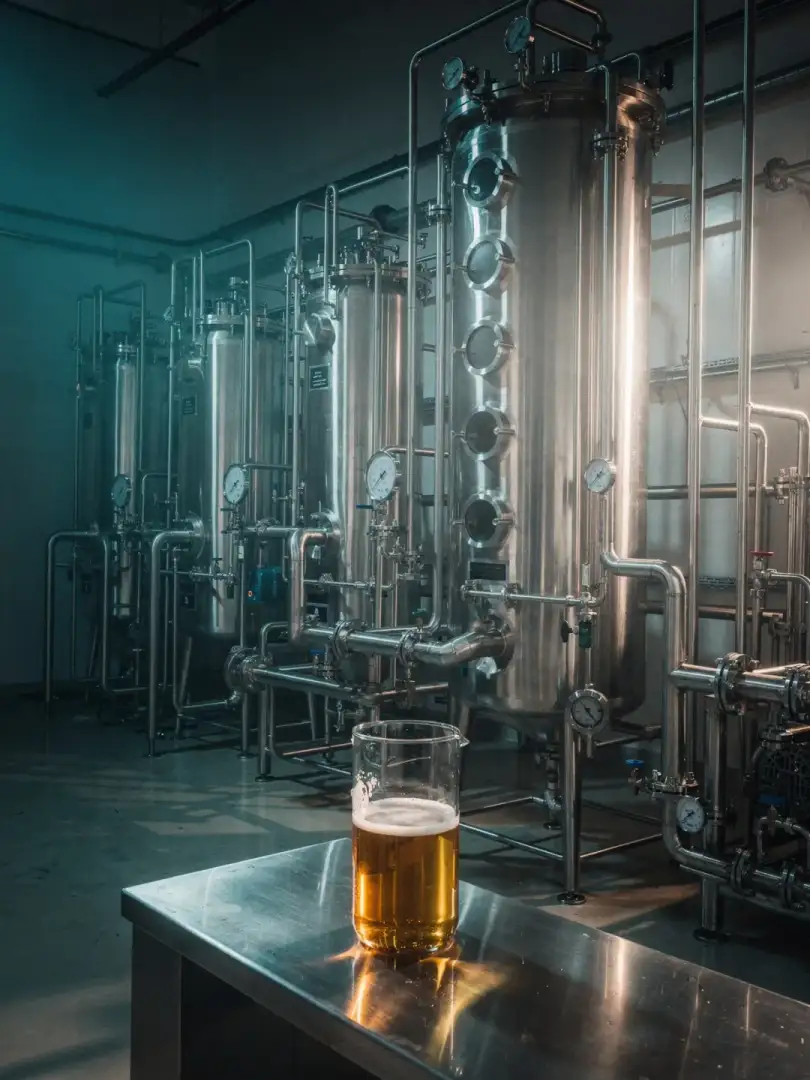
The solution lies in reduced pressure. In a vacuum system, the boiling point drops, much as water boils below 100°C at high altitude. According to technical literature, modern systems operate well below 40°C (104°F). The beer runs as a thin film over heated surfaces in what's called a falling-film evaporator, or passes through a column where vapor and liquid flow in opposite directions. The alcohol evaporates first and is drawn off. What remains is a beer with very little alcohol, one that, depending on the equipment, can be brought all the way down to 0.0.
Older systems ran hotter. That's where the reputation of some early alcohol-free beers comes from, tasting like cooked wort. If that's the image still stuck in your head, it's worth giving today's beers a fresh try.
Reverse Osmosis and Dialysis: Alcohol Through the Membrane
The second route skips heat entirely. In reverse osmosis, a pump forces the beer at high pressure against a membrane, a film riddled with tiny pores. Water and alcohol are small molecules and slip through. Larger components like residual sugars, proteins, color compounds, and many bittering substances get left behind. Such systems typically run cold, below 10°C (50°F). Afterward, the brewery adds de-alcoholized water back into the concentrated beer to restore its original strength.
In dialysis, the beer flows alongside a membrane, with a low-alcohol liquid flowing on the other side. The alcohol migrates naturally toward the side with the lower concentration, without the need for high pressure. Membranes are gentle on color, clarity, and many aromas. Reaching very low alcohol levels with membranes alone is more demanding, though, which is why some systems combine membrane filtration with distillation.
What happens to the aroma during de-alcoholization?
Every method carries off more than just alcohol. During evaporation, volatile compounds go along for the ride, including esters (fruity aroma compounds formed by yeast during fermentation) and some of the hop aroma. Many systems capture these compounds for this very reason. The aromas are separated out of the vapor and added back into the beer, a process experts call aroma recovery.
Blending is also common. The brewery mixes a little unfermented wort, or a beer from arrested fermentation, into the de-alcoholized beer to restore sweetness and body, as long as it stays under the 0.5% ABV threshold. German beer must still follow the same ingredient rules as always: barley malt, hops, yeast, and water, plus other malts for top-fermented styles. So what's added back is the beer's own aroma, not something foreign.
De-Alcoholized or Arrested Fermentation: How to Tell
Labels rarely state the method used. Look for phrases like "gently de-alcoholized" or "brewed with special yeast" as clues. In the glass, a de-alcoholized beer tends to taste leaner and drier, since it was fully fermented first and has little residual sugar. Beers from arrested fermentation, on the other hand, often taste sweeter and maltier. The equipment involved is expensive, and for small breweries, investing in their own system often doesn't pay off. The next section looks at the other approach: preventing alcohol from forming in the first place.