First Traces
When Was Beer Invented?
No one invented beer on a single day. The oldest traces researchers interpret as beer residue are around 13,000 years old and come from the Raqefet Cave in Israel. They predate farming altogether. Solid evidence for beer only appears later, in Mesopotamia and Egypt.
When Was Beer Invented? What the Finds Really Say
Every beer begins with a problem: grain contains starch, and yeast cannot ferment starch. Only when grain sprouts or is cooked do sugars form that yeast can turn into alcohol and carbon dioxide. Anyone brewing beer must first break down that grain. This is exactly the trace archaeologists look for when searching for the oldest beer.
The trouble is, beer leaves almost nothing behind. Liquid evaporates, wood and leather rot, and yeast vanishes after millennia. What remains are residues on stone vessels, starch grains visible under a microscope, and calcium oxalate, also called beerstone, a hard deposit that forms on vessel walls during mashing and fermentation. These traces are clues, not proof. That's why serious texts don't say "beer was brewed here," but rather "researchers interpret this find as beer."
Raqefet Cave: Beer Before Farming?
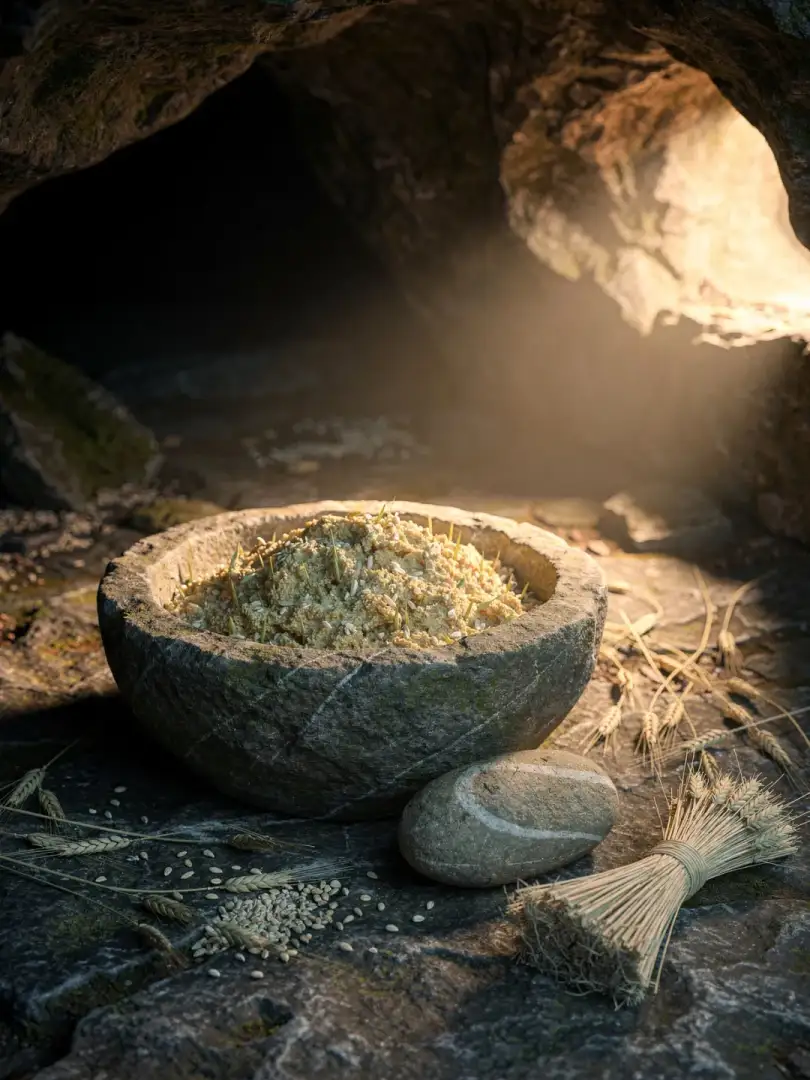
In Raqefet Cave on Mount Carmel in Israel, people of the Natufian culture buried their dead. They were hunter-gatherers who had already settled down in part. A team led by Stanford archaeologist Li Liu examined three stone mortars from this burial site in 2018, dated to between 13,700 and 11,700 years ago.
In the mortars, the researchers found starch grains with features that form during malting and heating, along with remains of wheat or barley, oats and legumes. Their interpretation: the Natufians malted wild grain, letting it germinate, and brewed from it a porridge-like, mildly alcoholic drink, likely for funerary feasts. That would make it thousands of years older than the first cultivated grain in the Near East.
The study is controversial. Critics argue the starch traces could just as easily be remnants of porridge or flatbread, and doubt that fermentation can be proven from a mortar alone. The only undisputed fact: people there processed grain in a way consistent with brewing.
Göbekli Tepe: Stone Troughs and Feasting
Göbekli Tepe in southeastern Turkey is a complex of large, decorated stone pillars, built starting around 9600 BC, roughly 11,600 years ago. The German Archaeological Institute has been excavating there since the mid-1990s. In later layers, excavators found large stone vessels holding up to 160 liters.
Oliver Dietrich and colleagues published initial analyses in the journal Antiquity in 2012. Martin Zarnkow of the Technical University of Munich in Weihenstephan examined gray residues on six vessels; tests for calcium oxalate came back positive in some cases. The authors themselves explicitly called this preliminary. Their theory: large feasts, fueled by beer, might have brought together the people who worked on the structures.
This is not proven. Calcium oxalate can also originate from plants or soil. Anyone writing about Göbekli Tepe today should speak of a well-founded hypothesis, not the world's oldest brewery.
First Confirmed Beer: Godin Tepe near Mesopotamia
Firmer ground appears about 5,000 years later. Godin Tepe, in Iran's Zagros Mountains, was home to a trading post from the late Uruk period, roughly 3500 to 2900 BC. In a jug with grooves carved into its inner wall, researchers led by Patrick McGovern found yellowish deposits identified as calcium oxalate. Here, barley, jug shape and residue all line up.
Writing emerges in Mesopotamia around this same time. From this point on, no one needs to interpret residue anymore: clay tablets name beer, its ingredients, and who received it. This marks the end of beer's prehistory and the beginning of its recorded history.
Bread or Beer: Which Came First?
Since the 1950s, researchers have debated whether people first cultivated grain for bread or for beer. Raqefet and Göbekli Tepe have given the beer theory a boost. No final verdict has been reached, and both likely existed side by side: porridge, flatbread and fermented drinks all made from the same grain. What is certain is that beer wasn't invented by a single person, but emerged independently in multiple places from grain porridge that began to ferment.