Ninkasi and the Pharaohs
Beer in Sumer and Egypt
Beer was a staple food, wage and offering in Sumer and Egypt. Clay tablets list beer as a ration, a hymn to the goddess Ninkasi describes the brewing process, and in Egyptian Abydos archaeologists uncovered a large-scale brewery roughly 5,000 years old.
Beer in Mesopotamia: Rations on Clay Tablets
In the cities of Mesopotamia between the Euphrates and Tigris, beer became part of everyday life. Temples and palaces managed barley stocks, and a good portion of the earliest cuneiform tablets are essentially bookkeeping: who received how much grain, bread and beer. Beer was part of wages, much like bread, and for many workers it was a key source of daily nutrition.
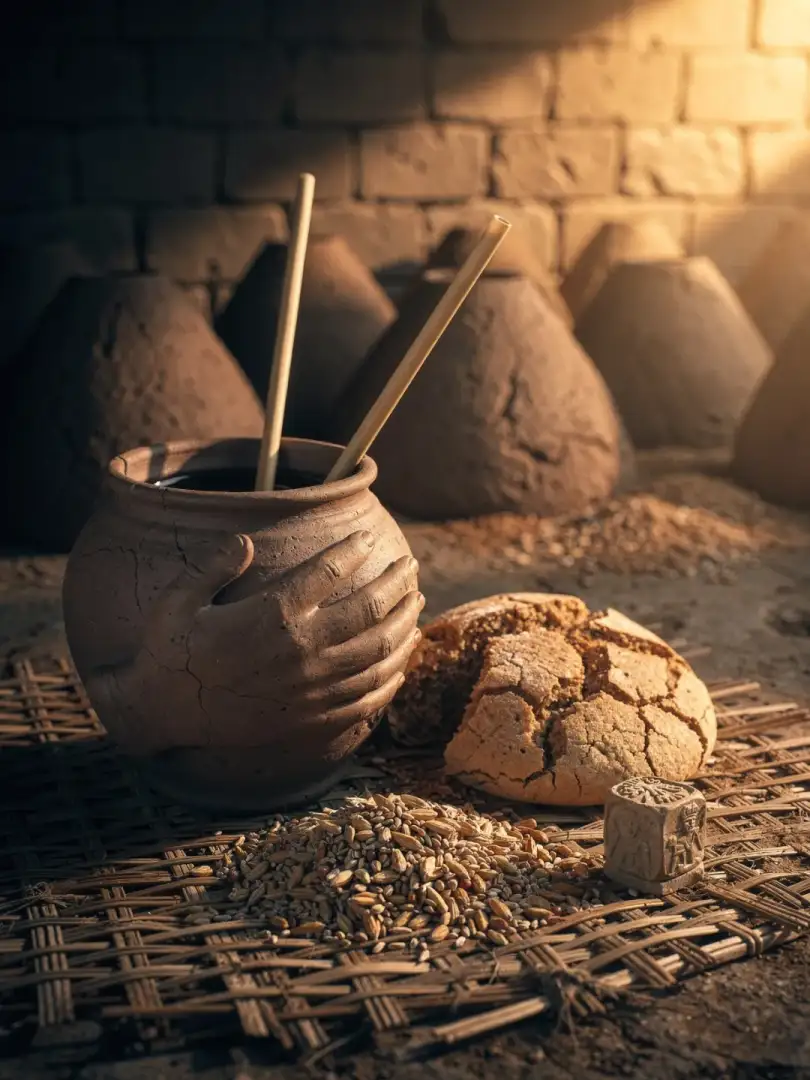
It was often drunk through straws from a shared vessel. Cylinder seals, small carved stone cylinders, show people drinking with long reeds from large jugs. The reason was practical: the beer was unfiltered, with husks and solids floating on top or settling at the bottom. The straw let drinkers reach the clear liquid in the middle.
The Ninkasi Hymn: A Recipe in Verse?
Ninkasi was the Sumerian goddess of beer. A hymn in her honor survives on clay tablets from the 18th century BC, nearly 4,000 years old. The hymn describes how Ninkasi mixes dough with spices, soaks malt, spreads the mash on mats, and lets the beer run into a collecting vessel.
The hymn is often called the oldest beer recipe. That's an interpretation. Translation of many technical terms remains uncertain, and a hymn of praise is not a set of brewing instructions. Breweries have recreated the hymn's beer multiple times; these experiments show what was possible, not necessarily what Sumerians actually drank.
One disputed point concerns the role of bread. The Sumerian word bappir is often translated as "beer bread," a baked loaf of grain crumbled into the mash. Whether bappir was truly bread or more a mixture of malt and flavoring agents remains an open question among scholars.
Beer and Law: The Tavern Keepers Under Hammurabi
Around 1750 BC, the Babylonian king Hammurabi had a collection of legal statutes carved in stone. Several paragraphs concern tavern keepers. They regulate, for instance, the ratio at which beer could be sold for grain, and threaten harsh punishment if a tavern keeper failed to report conspirators on her premises. Beer was thus an early subject of price and public-order law, a pattern that runs throughout the entire history of beer.
Beer in Ancient Egypt: Abydos and Worker Rations
In Egypt too, beer, called henket in Egyptian, served as food, wages and grave offering. Tomb models and wall paintings show women and men brewing: grinding grain, setting dough in jars, pressing the mash through sieves. Ration lists for workers, including those building the pyramids, list beer alongside bread as a standard allotment.
In 2021, an Egyptian-American team led by Matthew Adams and Deborah Vischak uncovered a brewery in North Abydos likely dating to the reign of King Narmer, around 3100 BC. Eight sections, each holding roughly 40 clay vessels arranged in two rows, were used to heat the mash. According to the excavators, the facility could produce around 22,400 liters in a single batch. It's considered the oldest known large-scale brewery; the beer here was likely brewed for rituals at the royal tomb.
What Did Pharaonic Beer Taste Like?
No one knows for certain. Neither the Sumerians nor the Egyptians knew hops; bitterness and shelf life, if present at all, came from herbs, dates or spices. The beer was cloudy, fairly thick, slightly sour from lactic acid bacteria, and likely low in alcohol. Because it spoiled quickly, it was drunk fresh. It has about as much in common with a modern pilsner as flatbread has with a layer cake: the same basic ingredient, a completely different product.