Conglomerates and Craft
The World's Largest Breweries
The world's largest brewery is AB InBev. According to the report from hop trader BarthHaas, the conglomerate brewed around 495 million hectoliters in 2024, good for roughly a quarter of the world's beer. Heineken and China Resources Snow follow behind. At the same time, there are more small breweries than there have been in decades.
How Breweries Became Global Conglomerates
For a long time, beer was a regional product. It's heavy, bulky, and perishable, so it was brewed close to the customer. Refrigeration technology, railroads, bottles, and cans gradually changed that. In the 20th century, large breweries bought up smaller ones, first within their own countries, then across borders from the 1990s onward.
The key moves in recent times: in 2008, the Belgian-Brazilian InBev took over the US conglomerate Anheuser-Busch, maker of Budweiser, and renamed itself AB InBev. In 2016 came the acquisition of British-South African rival SABMiller. Heineken of Amsterdam and Carlsberg of Copenhagen also grew through acquisitions in Africa, Asia, and Latin America. Japanese groups such as Asahi bought up European brands, including Pilsner Urquell in 2017.
Who Brews the Most Beer? The Numbers
The annual BarthHaas report ranks the 40 largest brewing groups. For 2024, it lists AB InBev at 495.49 million hectoliters, or 26.4 percent of world production. Heineken follows with 240.7 million hectoliters, and China Resources Snow Breweries with 108.8 million. Together, the top 40 groups brewed around 86 percent of the world's beer.
Total world production in 2025 stood at just under 1.9 billion hectoliters, according to BarthHaas. Growth has nearly stalled: consumption is falling in Europe and North America while rising in parts of Africa and Asia. Politics is also reshaping the rankings. Russia placed Carlsberg's subsidiary Baltika under state control; the report now lists it as a separate company.
What Belongs to Whom? Brands and Owners
Many familiar names now belong to large conglomerates, though you'd never know it from the label. Beck's, Spaten, and Löwenbräu belong to AB InBev, Pilsner Urquell to Asahi, and Staropramen to Molson Coors. Heineken holds a 30 percent stake in the Munich-based Paulaner Brauerei Gruppe. Meanwhile, large family-owned breweries such as Krombacher, Warsteiner, Veltins, and the Bitburger Braugruppe remain independent, and Hofbräu München and Rothaus are even brewed by entire German states.
For drinkers, this means a brand with a long local history can today be owned by a global conglomerate. That says nothing about quality, but it does say a lot about who decides on the recipe, the brewing location, and the price.
A well-known example of the consequences is the dispute over the name Budweiser. The town of České Budějovice, known in German as Budweis, has its own brewery, Budějovický Budvar, founded in 1895. Anheuser-Busch has sold its Budweiser since 1876. For over a hundred years, the two have fought in courts across many countries over the names Budweiser and Bud. As a result, the Czech beer is sold in the US under the name Czechvar in some cases, while AB InBev sells under the name Bud in parts of Europe.
Craft Beer: The Counter-Movement
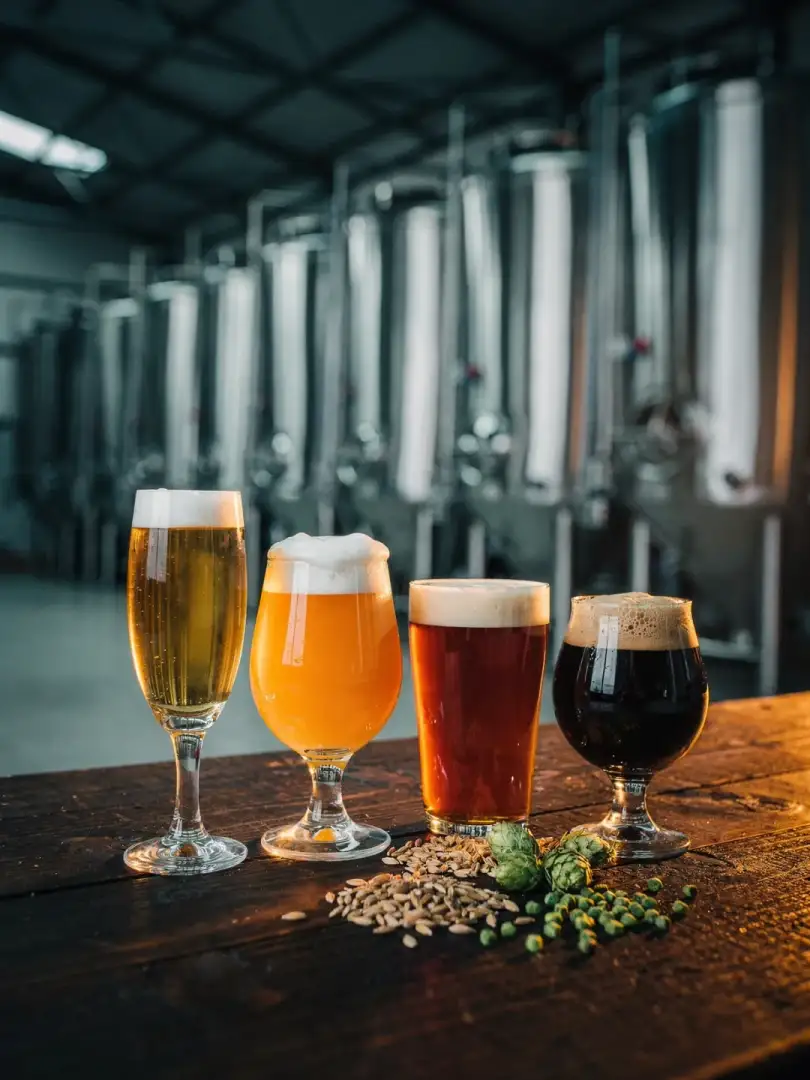
As a response to uniform mass-market lager, small breweries began appearing in the US from the late 1970s onward, brewing both old and new styles. Sierra Nevada, founded in California in 1980, is an early example. The US Brewers Association now defines a craft brewer as small, independent, and a traditional brewer: producing no more than six million barrels a year and less than 25 percent owned by an alcohol conglomerate that is not itself a craft brewer.
The big conglomerates responded by buying up successful craft breweries. In Germany, there's no legal definition of craft. According to the German Brewers' Association, there are around 1,500 breweries in the country, many of them small and regional, even though beer sales hit a low of around 78 million hectoliters in 2025. Concentration and diversity are thus growing side by side: a few giants brewing the bulk of the beer, and many small producers keeping the styles alive.