Herbs Instead of Hops
Before Hops: Gruit, Labrador Tea, Juniper, Gesho
Gruit is an herb blend once used in Northwestern Europe to season beer before and alongside hops, mainly featuring bog myrtle. Other brewing traditions used Labrador tea, juniper, or, in Ethiopia, gesho. Hops only became dominant in Central Europe during the High and Late Middle Ages.
What Is Gruit? Herbs Instead of Hops
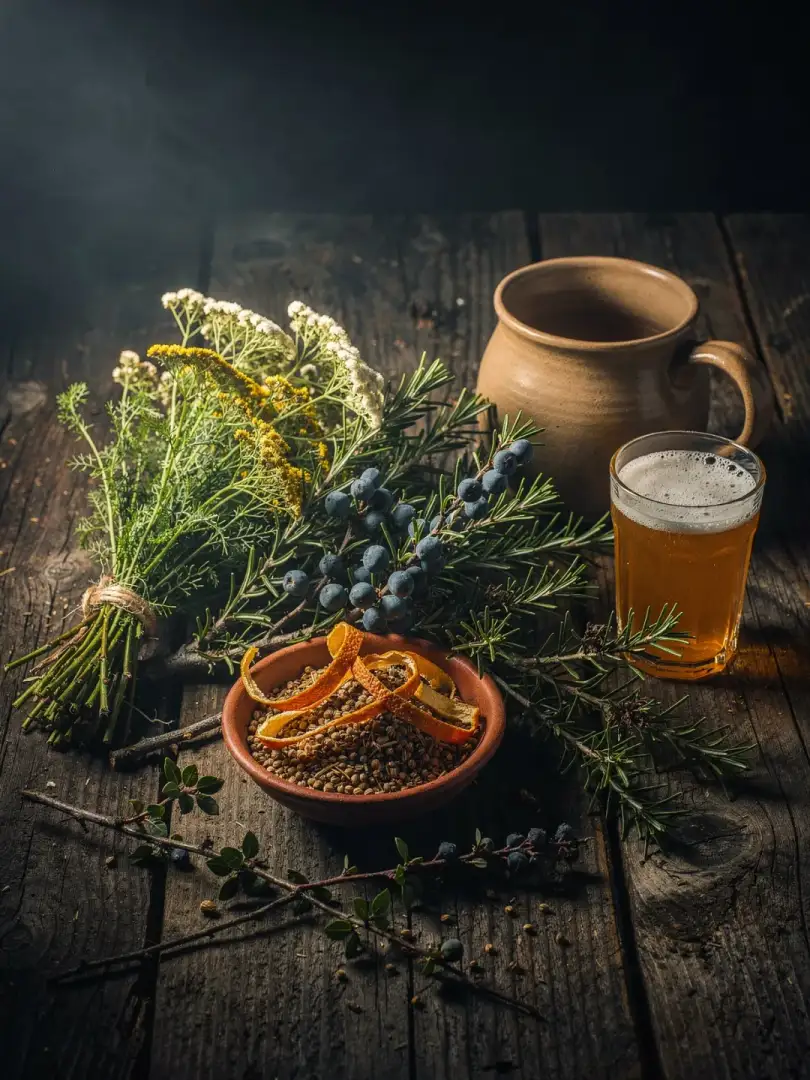
Anyone drinking beer in 11th-century Cologne or Utrecht likely got gruit beer. The spice blend consisted mainly of bog myrtle, a shrub found in moors and heathlands. Depending on the region, yarrow, rosemary, bay leaf, juniper, or resin were added too. The recipes were guarded by the holders of gruit rights; what exactly went into them often isn't recorded.
Bog myrtle tastes resinous, spicy, and slightly bitter, with hints of bay leaf and eucalyptus. Its bitterness is weaker than that of hops, and it offers less protection against spoilage. A gruit beer was therefore more of a fresh drink meant for quick consumption. How gruit rights functioned as a tax and a tool of power is explained in the journey to the Reinheitsgebot; here, the focus is on the plants and their flavor.
Labrador Tea and Juniper: Herb Beers in the North
Marsh Labrador tea, botanically Rhododendron tomentosum, grows in moors across Northern Germany, the Baltics, and Scandinavia. It has a strongly resinous, camphor-like aroma. The plant contains toxic compounds, and beer brewed with it was considered especially intoxicating and hard on the stomach. It's no longer used for brewing today, and for good reason.
Juniper held on longer. For Finnish sahti, brewers traditionally lauter the mash through juniper branches in a hollowed-out wooden trough called a kuurna. Lautering means separating the sweet liquid from the spent malt residue. Sahti is barely hopped or not hopped at all, tastes of juniper, banana, and bread, and has little carbonation. Norwegian farmhouse brewers also boiled juniper branches in their brewing water.
Gesho and Other Bittering Plants Worldwide
In Ethiopia, the homebrewed beer tella is spiced with gesho, botanically Rhamnus prinoides, a buckthorn relative. The leaves and branches provide bitterness and contribute to fermentation, since microorganisms live on them. The Ethiopian honey wine tej is also made with gesho. Tella is brewed from barley, millet, corn, or teff and is typically cloudy, tangy, and fairly low in strength.
Other cultures used bark and roots for bitterness, or skipped bittering altogether. Many African millet beers are sour rather than bitter, with the acidity protecting them from spoilage. Hops are thus a European solution to a universal problem: balancing sweetness and keeping the drink enjoyable for longer.
Why Hops Won Out Over Gruit
Early evidence of hops in monastic households comes from the statutes of Abbot Adalhard of Corvey on the Weser, dating to the year 822. From the 13th and 14th centuries onward, hopped beer spread outward from northern German Hanseatic cities like Hamburg, Bremen, and Einbeck. It held up better than gruit beer on long sea voyages and became a major export hit.
Hops proved more effective against spoilage and could be grown in gardens and dosed consistently. In England, unhopped ale remained the norm for a long time. Hopped beer arrived in the 15th century with traders and brewers from Flanders and the Netherlands, and for a while, the words ale and beer actually referred to two distinct drinks.
Herb Beer Today: Gruit, Gose, and Witbier
Craft brewers have revived gruit beers, using bog myrtle, yarrow, or heather. In Germany, such a beer needs a special exemption from the state authority as a special beer; according to the German Brewers' Association, this is possible in every state except Bavaria. Substituting hops entirely remains prohibited. Herbs may therefore complement hops, but not replace them.
Gose, spiced with salt and coriander, and Belgian witbier, with coriander and orange peel, belong to the same tradition of spiced beers. Both are hopped, but subtly; their character comes from the kitchen, so to speak. Gose originally comes from Goslar and is also classified as a special beer in Germany, since it deviates from the Reinheitsgebot.