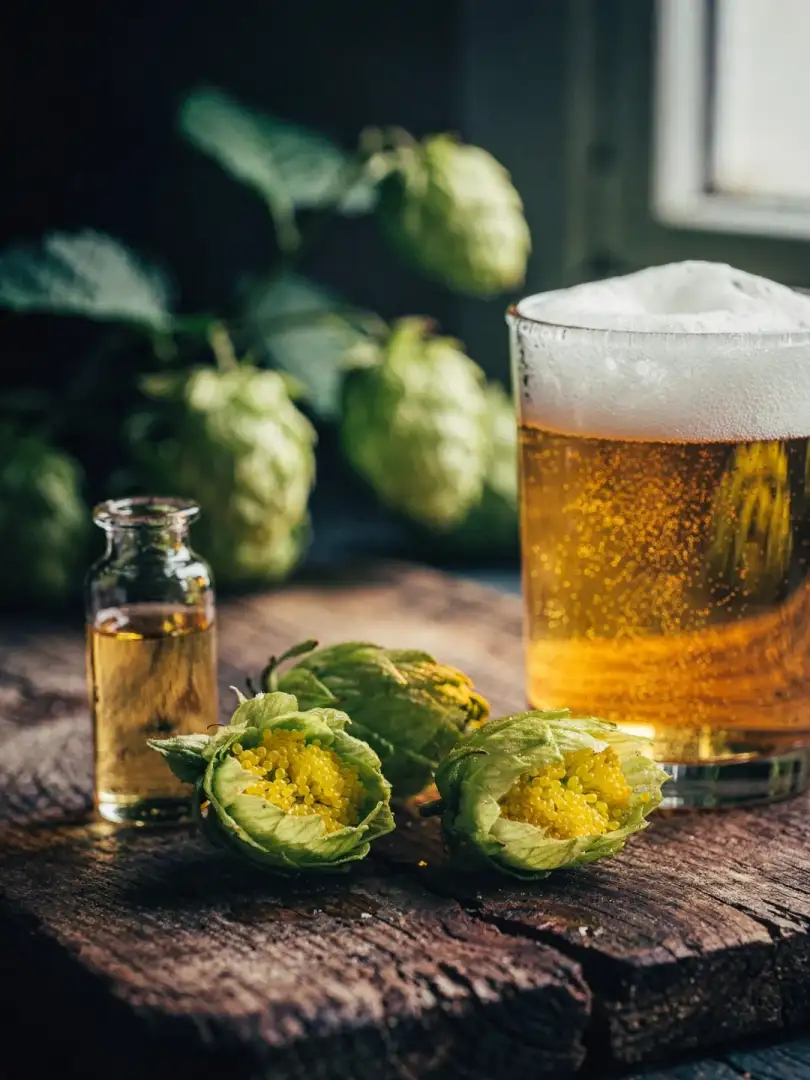
Hops and Hormones
Does Beer Give Men Breasts? Hops and Phytoestrogens
The claim that hops in beer make men grow breasts isn't supported by evidence. While hops do contain a potent phytoestrogen, beer contains only very small amounts of it. Breast growth in men is more closely linked to being overweight or to heavy alcohol consumption than to hops.
What Are Phytoestrogens in Hops?
Phytoestrogens are plant compounds that can act in the body somewhat like the female hormone estrogen, only much more weakly. They're found in soy, flaxseed, and indeed in hops. In the late 1990s, researchers identified a substance in hops called 8-prenylnaringenin, or 8-PN for short. It's considered one of the most potent known phytoestrogens.
This discovery fit with old reports. Hop pickers were said to have experienced menstrual irregularities after working with the cones for weeks on end. Whether this account is accurate, and whether it's truly linked to 8-PN, isn't well established. Still, it shows why hops have long had a reputation for affecting hormones.
How Much Phytoestrogen Is Actually in Beer?
Very little. Measurements around the year 2000 found no detectable 8-PN in many beers, and in the rest typically only a few to around 20 micrograms per liter. A microgram is one-millionth of a gram. Only a small fraction of the 8-PN from the hops even makes it into the finished beer. How much depends on the hop variety, the amount of hops used, and the type of hop product.
One uncertainty remains. Beer contains more isoxanthohumol, a related compound that gut bacteria can convert into 8-PN. How much this happens varies greatly from person to person. Even in people who convert it efficiently, the amounts involved are, based on current knowledge, far below what would be needed for a noticeable hormonal effect. However, the research on this is thin and not conclusive.
Where Do Man Boobs Really Come From?
True breast gland growth in men is called gynecomastia in medicine. It has many possible causes: puberty, aging, certain medications, or liver or testicular conditions. More common than true gynecomastia is fat accumulation in the chest due to being overweight. Fatty tissue can convert male hormones into estrogen, which amplifies the effect.
Long-term heavy alcohol consumption can disrupt the hormone balance, especially when the liver is damaged. A damaged liver breaks down estrogen less effectively, and testosterone levels can drop. This applies to any form of alcohol—spirits and wine just as much as beer. Based on current knowledge, this connection has little to do with hops specifically.
Are Hops in Beer Healthy?
Besides 8-PN, hops contain another well-researched compound: xanthohumol, a yellow plant pigment from the lupulin glands of the cone. In the lab, it shows effects that interest researchers, such as antioxidant activity. Marketing copy likes to turn this into claims that beer is healthy. That's a logical leap too far.
During brewing, most of the xanthohumol converts into other compounds, leaving only a small amount in the finished beer. To reach the quantities used in lab studies, you'd have to drink so much beer that the alcohol would far outweigh any possible benefit. Reputable health organizations therefore don't recommend alcohol for health reasons. People drink beer because it tastes good and suits a meal or good company, not because of its hop compounds. This holds true in both directions: hops neither protect against disease nor transform men.
What Remains Unclear About Hops and Hormones
An effect from hop compounds isn't entirely ruled out. 8-PN is being studied as a possible treatment for menopause symptoms, but at doses many times higher than what's found in a beer. Results from lab experiments and studies using concentrated extracts can't be applied to a glass of beer.
Even non-alcoholic beer contains hops, and thus traces of these compounds. It's sometimes marketed as a sleep aid, since hops are said to have a calming effect. Such claims come from manufacturers and aren't proven health benefits. Anyone with health questions is better off discussing them with a doctor than with a beer label.