1516 and today
Myths about the Reinheitsgebot: what really applied in 1516
The Reinheitsgebot of 1516 applied only in Bavaria, never mentioned yeast, and was originally a beer-pricing regulation. The term itself isn't documented until 1909. Today, Germany has no law by that name, only remaining provisions of the Beer Law and the Beer Ordinance.
Did the Reinheitsgebot apply to all of Germany in 1516?
No. The territorial ordinance now celebrated as the Reinheitsgebot was passed by the Bavarian dukes Wilhelm IV and Ludwig X in 1516 in Ingolstadt. It applied only within the reunified Duchy of Bavaria, covering towns, markets, and the countryside. Other German territories had their own rules, or none at all. A comparable regulation at the national level didn't arrive until 1906 with the Beer Tax Law, and even then only for bottom-fermented beer.
The famous date is also a stumbling block. The ordinance bears the date April 24, 1516, but it wasn't finally debated and printed until July. April 23 is German Beer Day, observed by the Brewers' Association since 1994. If you want to be precise, just write: 1516 in Ingolstadt.
Water, malt, hops, yeast: was that really written down?
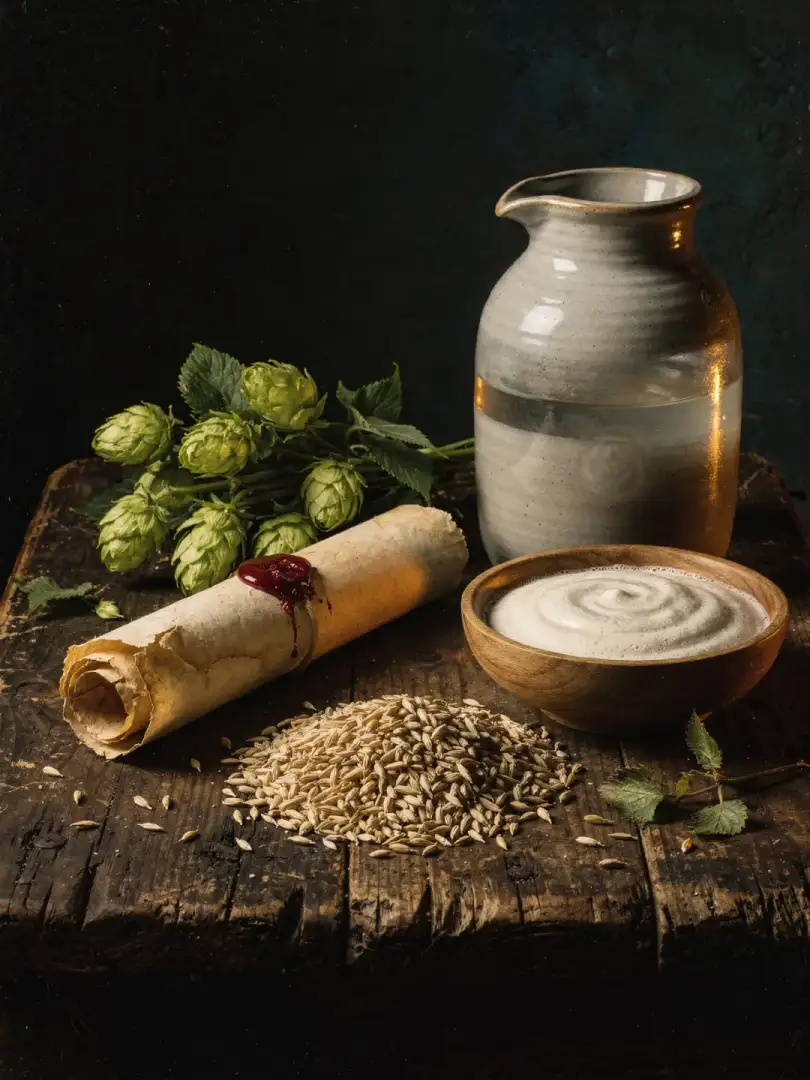
The 1516 wording permits "only barley, hops, and water." Yeast is missing, because no one knew yet that a living organism converts sugar into alcohol. Brewers used yeast anyway, carrying over the sediment from one brew to start the next. In Bavaria, yeast wasn't explicitly named in the law until 1910. Bamberg, incidentally, had already named it in its own ordinance back in 1489.
The order of the provisions is also surprising. Under the heading of how beer should be served and brewed in summer and winter in the countryside, the ordinance first addressed maximum prices per measure. The ingredients came afterward. The law was therefore primarily a pricing and market regulation. Consumer protection in the modern sense wasn't a stated goal, even though the ingredient rule did make adulteration harder.
Was the Bavarian Reinheitsgebot the first?
Not that either. Older rules for beer ingredients existed in Weimar in 1348, Landshut in 1409, Weißensee in Thuringia in 1434, Regensburg in 1447, and Munich in 1487. The Munich Order of 1487 already stated "hops, barley, and water." Even London had its own regulation in 1484. The year 1516 became famous because it later served as the reference point for all of Bavaria and eventually for Germany as a whole.
The word Reinheitsgebot itself is not nearly 500 years old. According to current knowledge, it first appears in 1909 in the Reichstag. Before that, people spoke of the Surrogatverbot, the ban on substitute ingredients for malt and hops. The claim that the term originated in 1918 in the Bavarian state parliament is now considered outdated.
Is beer brewed under the Reinheitsgebot automatically better?
Many advertising slogans suggest so. But the ingredients list says little about how good a beer actually tastes. Even under German law, hop powder and hop extracts are permitted, as are clarifying agents that work mechanically or by adsorption and are then filtered out again. A beer made from barley malt, hops, yeast, and water can be outstanding or dull, depending on the raw materials, the recipe, and the care taken in the brewhouse.
Conversely, some of the world's most respected beers don't fit this framework at all. Belgian brewers use candi sugar, spices, or fruit; British brewers often add sugar; witbier contains coriander and orange peel. These beers aren't impure because of it—they simply follow a different tradition. The German law is a rule for German breweries and has shaped the character of German beer. It is not a quality verdict on every other beer in the world.
What law governs German beer today?
There is no law actually called the Reinheitsgebot. The Provisional Beer Law was repealed in 2005, but its Paragraphs 9, 11, and 18 still apply. On top of that come the Beer Ordinance of 1990 and an implementing regulation. Under these rules, only barley malt, hops, yeast, and water are allowed for bottom-fermented beer. For top-fermented beers such as Weissbier, Kölsch, or Altbier, other malts and certain sugars may be used outside Bavaria.
Two further misconceptions persist stubbornly. Since a 1987 ruling by the European Court of Justice, imported beer may be called beer in Germany if it's considered beer in its country of origin. And beer with cherries or coriander can also be approved here as a "special beer," upon application to the relevant state authority—according to the German Brewers' Association, in every state except Bavaria. It remains unclear whether the claim "brewed according to the Reinheitsgebot" would be permitted for such beers; there is no clear rule on this.