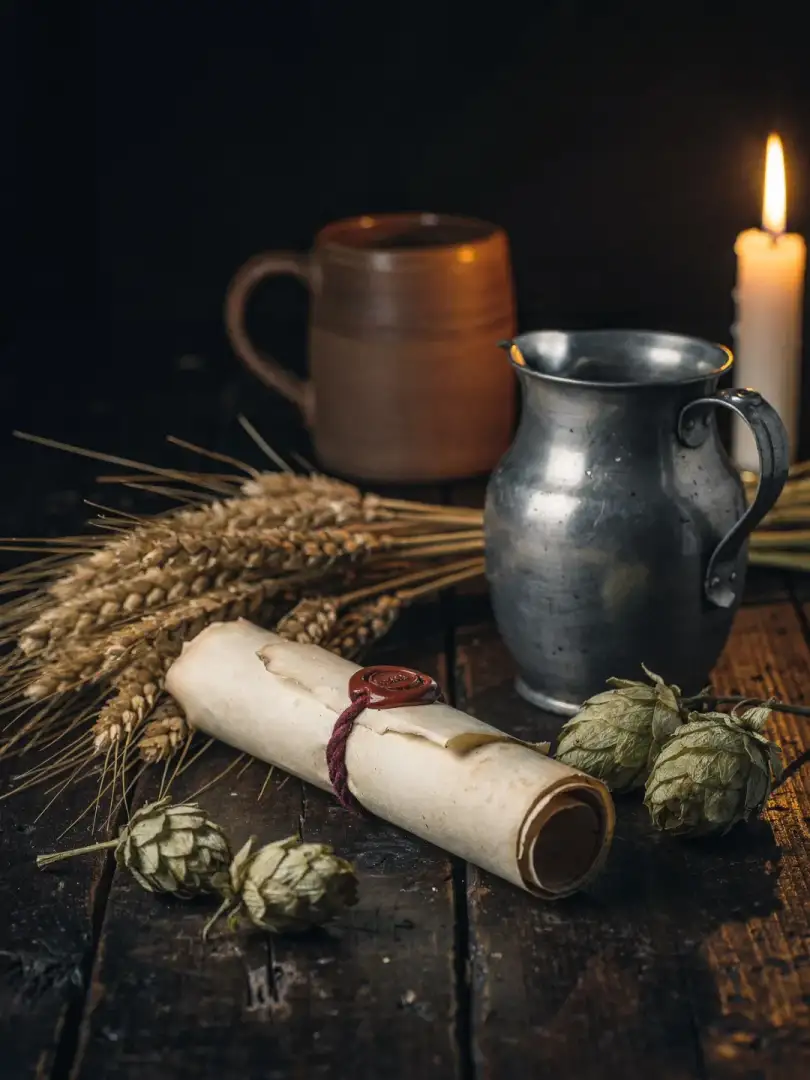
The 1516 Text
What Does the 1516 Reinheitsgebot Actually Say?
The 1516 Reinheitsgebot states that beer should be brewed solely from barley, hops and water. Yeast is missing, and the word Reinheitsgebot doesn't even appear in the text. The rule was part of a Bavarian territorial ordinance, passed in 1516 in Ingolstadt, and it began with beer prices.
What Does the 1516 Reinheitsgebot Literally Say?
The territorial ordinance from which the famous sentence originates is dated 24 April 1516. It was only finally deliberated and printed in July 1516 at the Landtag in Ingolstadt. It was issued by Dukes Wilhelm IV and Ludwig X, who jointly ruled Bavaria at the time. The section on beer carries a lengthy heading: "Wie das Pier Summer und Wintter auffm Lannd sol geschennckt geprawen werden." Translated, this means: how beer should be served and brewed in summer and winter in the countryside.
The text first sets maximum prices. Winter beer was allowed to cost one Munich pfennig per measure, summer beer, then called "Mertzen," two pfennigs. Only after that comes the sentence that became famous. No more ingredients were to be used in any beer than "allain Gersten, Hopffen und Wasser" — barley, hops and water alone. Barley here means barley malt, i.e. grain that was allowed to germinate and was then dried. Hops provide bitterness and make the beer keep longer. Water is by volume the largest component of any beer.
Why Is Yeast Missing from the Reinheitsgebot?
Without yeast, no alcohol is produced. Yet the 1516 text doesn't mention it, and there's a simple reason for that. Brewing was of course done with yeast: brewers passed the sediment from a successful batch on to the next one, or let the wort — the sweet liquid from the brewhouse — begin fermenting on its own. But nobody knew what was actually working in the vat. That yeast is a living organism, a tiny single-celled fungus, was only clarified by researchers such as Louis Pasteur and Emil Christian Hansen in the 19th century.
Other places were already further along in their wording. A Bamberg ordinance from 1489 already names yeast explicitly. In Bavaria it only entered the law expressly in 1910, through an amendment to the Malt Surcharge Act, the law governing the tax on malt. There it reads "Malz…, Hopfen, Hefe und Wasser" — malt, hops, yeast and water. The four ingredients that today adorn so many labels are thus a 20th-century formula. They match the 1516 text only three-quarters of the way.
Did the Reinheitsgebot Apply to All of Germany?
No. The ordinance applied within the Duchy of Bavaria, which had just been reunified, covering towns, market towns and the countryside. Franconia, Swabia, Saxony or the Rhineland were not included. A Germany in today's sense didn't exist anyway. Every territorial ruler and many towns regulated their own beer, some more strictly, many more generously. In the north, brewers continued for a long time to season with herbs, towns brewed wheat beers, and sour beers were sold that would have been banned in Bavaria.
The name, too, is much younger than the rule. The word Reinheitsgebot is a coinage of the early 20th century and, according to current research, is first documented in 1909 in the Reichstag. Before that, people spoke soberly of the Surrogatverbot, the ban on substitutes. A surrogate is a substitute substance — meaning ingredients that replace malt or hops and make brewing cheaper. The claim often repeated, that the term originated in 1918 in the Bavarian state parliament, is now considered outdated.
Why Only Barley? Interpretations and Consequences for Weissbier
The text doesn't say why the dukes prescribed barley. One common interpretation holds that wheat and rye were meant to be left to the bakers, since they were needed as bread grains. Another points to herbal additives, which could spoil beer or make its intoxicating effect unpredictable. Both sound plausible, but neither is confirmed by the wording. What's certain is only the order: price first, then ingredients. The regulation was therefore not a consumer protection law in the modern sense, but rather a price and market ordinance.
For beer styles, the barley rule has a remarkable consequence. A Weissbier made from wheat malt strictly contradicted it from the very start. That Bavaria nonetheless became a land of Weissbier is owed to special privileges granted soon after 1516. Helles and Weissbier, today both Bavarian classics, thus have, legally speaking, very different origins.
Another date often misleads people. German Beer Day on 23 April is not an exact anniversary. The Brewers' Association has observed it since 1994, while the document itself is dated 24 April. Those who want to be precise simply say: decreed in 1516 in Ingolstadt.