What the seal is really worth
Reinheitsgebot: quality seal or marketing?
The Reinheitsgebot isn't a quality seal, it's more of an ingredients rule. It states what may go into German beer, but says nothing about freshness, ingredient quality, or a brewery's skill. "Brewed according to the Reinheitsgebot" isn't a legal term, just a voluntary marketing claim.
What the Reinheitsgebot actually guarantees
The rule's strength lies in its clarity. A German Pils or Helles contains barley malt, hops, yeast, and water—no corn starch, no rice, no syrup. Substitutes for malt and hops are banned in German beer, even with special exemptions. For allergy sufferers and the curious, that's a reliable guarantee. And for the character of many lager beers, it's a genuine framework: malt and hops alone have to carry the flavor.
What the rule doesn't check is just as important. It says nothing about how fresh a beer is, how good the barley was, how carefully it was mashed and matured. A stale Pilsner from the supermarket shelf satisfies the law just as much as a freshly tapped cellar beer. Quality is made in the brewhouse and the cellar, not in the ingredient list alone.
What's allowed despite the Reinheitsgebot
Even the law leaves room that many people don't know about. Hops may go into beer as powder or extract, meaning as a concentrated form rather than whole cones. Clarifying agents are permitted as long as they only bind or filter out haze-forming particles and are completely removed afterward. Well-known examples are kieselguhr, a fine rock powder made from diatoms, and PVPP, a synthetic granulate that binds haze-causing tannins. Neither should remain in the finished beer.
Under the law, malt is defined as any artificially germinated grain. And for top-fermented beers outside Bavaria, sugar and sugar-based colorants are permitted. So an Altbier or a Weizen from North Rhine-Westphalia may contain ingredients that a Bavarian Weissbier is not allowed to contain. Both are nonetheless flawless German beer. Anyone who understands "pure" as "all-natural" is only half right.
Then there's the technology. Large breweries filter, stabilize, and pasteurize their beer, briefly heating it so it survives months on the shelf. All of this is compatible with the Reinheitsgebot, because no new ingredient remains in the beer. An unfiltered cellar beer straight from the cask and a long-life bottled beer carry the same statement on the label.
Which beers the Reinheitsgebot excludes
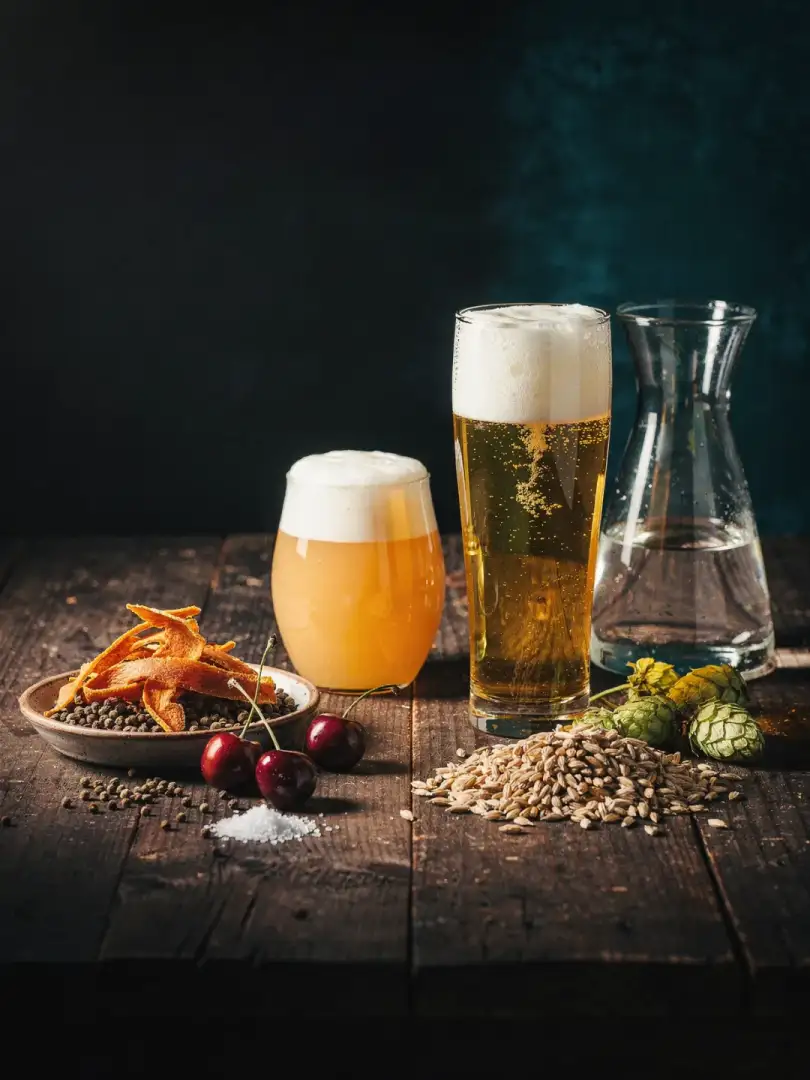
The price of clarity is narrowness. A Belgian witbier lives on coriander and orange peel. A Gose needs salt and coriander, a milk stout needs lactose, which counts as neither cane, beet, nor starch sugar. Fruit beers, herbal beers, and many creations from the craft scene fall outside the rules too. Brewed in Germany, they need a special exemption as a specialty beer, and according to the Brewers' Association, no such exemption exists in Bavaria.
Critics see this as a competitive disadvantage and a reason why certain beer styles were long absent in Germany. Supporters counter that this very restriction sharpened the art of lager brewing. Both sides have a point. It's documented that the rule has also protected markets throughout its history: until the 1987 ECJ ruling, foreign beers with different ingredients couldn't be sold as beer in Germany.
A look at Belgium shows the other side. There, candy sugar in a Tripel and spices in a witbier are considered part of tradition, not a flaw. Good and weak beers exist there just as they do here. The ingredient list alone doesn't sort them.
Advertising with the Reinheitsgebot: what's behind it?
"Brewed according to the German Reinheitsgebot" appears on countless labels. Legally, this is a voluntary claim, permissible if the beer complies with the ingredient rules under § 9 of the Provisional Beer Law. There's no official government seal of approval for it. Since almost every German beer has to meet the rule anyway, the phrase barely distinguishes one brewery from its neighbors.
Its value lies elsewhere. The Reinheitsgebot is a piece of identity, a selling point abroad, and for many brewers, a deliberate stance. A good beer sommelier takes it for what it is: a promise about ingredients, not a verdict on taste. Whether a beer is good is shown by nose, palate, and freshness. Anyone who wants to judge that for themselves will find the tools in our tasting journey.