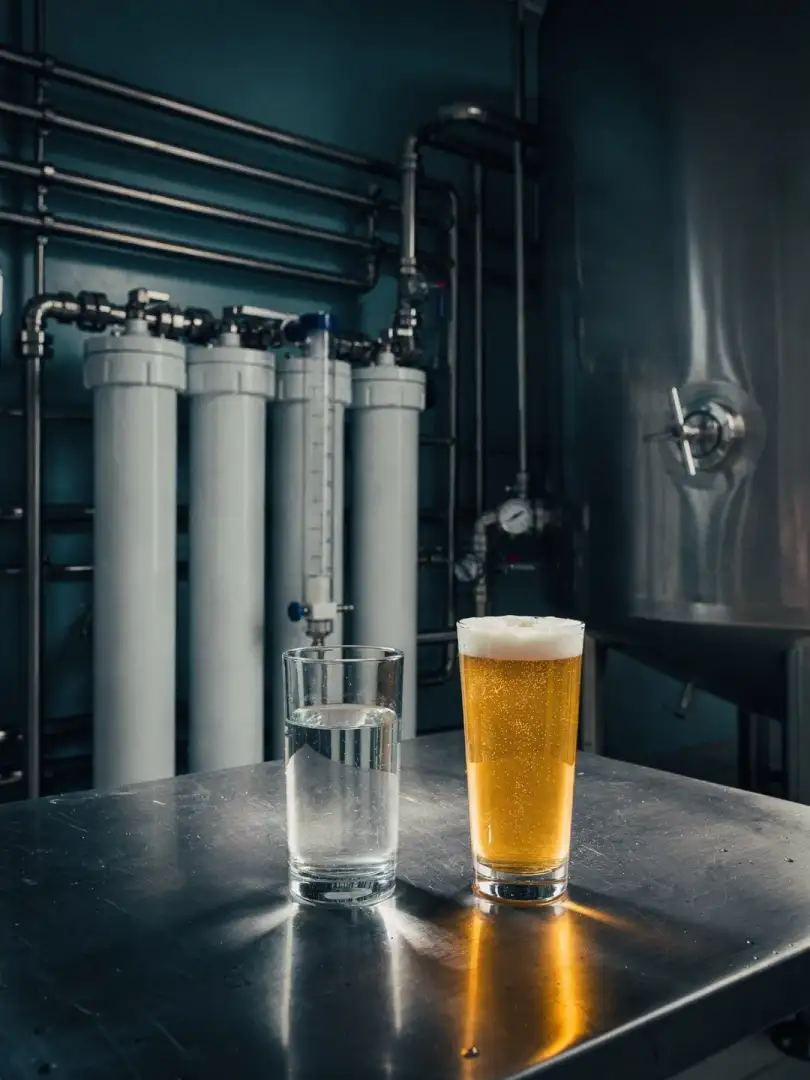
Water made to order
Treating brewing water: how breweries build their water today
Nearly every brewery treats its brewing water today: filtered, softened, desalinated via reverse osmosis, and then deliberately re-mineralized. This way, any brewery can recreate any water profile, whether Pilsen's or Burton's. What methods exist, and what they do to the beer.
Why do breweries treat their water?
Most breweries today want to brew several styles and have every batch taste the same, week after week. But local water fluctuates with the season and the source, and it rarely suits every beer in the lineup. A pilsner calls for soft water, a pale ale for sulfate-rich water, a stout can handle carbonate. Treatment resolves this contradiction: you start with a known base water and adjust it to suit each beer.
The first duty is safety. In Germany, water used in food production facilities must generally meet drinking water quality under the Trinkwasserverordnung (Drinking Water Ordinance); only the authorities can grant exceptions. Only after that does taste come into play. Breweries with their own well have their water tested regularly; breweries on the municipal network get the figures from the utility and verify them.
Filtering, dechlorinating, softening: the basic steps
It starts with filters that hold back sand, rust and sediment. Activated carbon binds chlorine and chloramine from the disinfection of tap water, as well as odors and organic traces. This matters because chlorine combines with compounds from malt to form chlorophenols, which smell like plasters or medicine. Iron and manganese are removed through aeration and filtering, otherwise the beer tastes metallic.
Excess bicarbonate can be reduced in several ways. During boiling, some of it precipitates out as lime. In lime decarbonization, lime milk is added, which precipitates the bicarbonate. Ion exchangers swap dissolved minerals for others. For many operations, blending is also the simplest solution: hard water is mixed with desalinated water until the desired hardness is reached. Which method a brewery chooses depends on its raw water, its size and its beers. A brewery that only makes a pilsner needs less equipment than one brewing twenty different styles.
What is reverse osmosis in brewing water?
In reverse osmosis, water is forced under high pressure through a very fine membrane. Water molecules pass through, but most dissolved salts don't. What comes out is nearly mineral-free water, roughly comparable to—or even softer than—a Pilsen well. Many breweries use it as a blank canvas, onto which they paint the right minerals for each recipe.
This isn't without its downsides. The equipment uses energy, and part of the water runs off as concentrated wastewater. Pure osmosis water is also too stripped-down to brew with: without calcium, the mash and yeast perform worse. That's why breweries add minerals back in afterward, or blend it with their raw water. The goal isn't the purest water, but the right one. Small breweries and homebrewers work on the same principle, just with simpler means: they mix tap water with distilled water until the hardness is right, and calculate salt additions using a water calculator.
Salts and acidification: the fine-tuning
Adjustments are made mainly with gypsum for sulfate and calcium, calcium chloride for chloride and calcium, and in small amounts Epsom salt for magnesium. This turns neutral water into a Burton profile for a dry pale ale, or chloride-forward water for a soft, hazy IPA. In countries without the Reinheitsgebot, brewers often also acidify the mash with lactic or phosphoric acid to lower the pH.
In Germany, bottom-fermented beer falls under the strict ingredients law of § 9 of the Provisional Beer Law (Vorläufiges Biergesetz). German brewers therefore traditionally lower the pH through biological acidification: lactic acid bacteria ferment sugar into lactic acid in a portion of the wort, and this sour mash is then added to the main mash. How far salt additions to brewing water are permitted under German beer law is interpreted differently. When in doubt, ask the brewery itself.