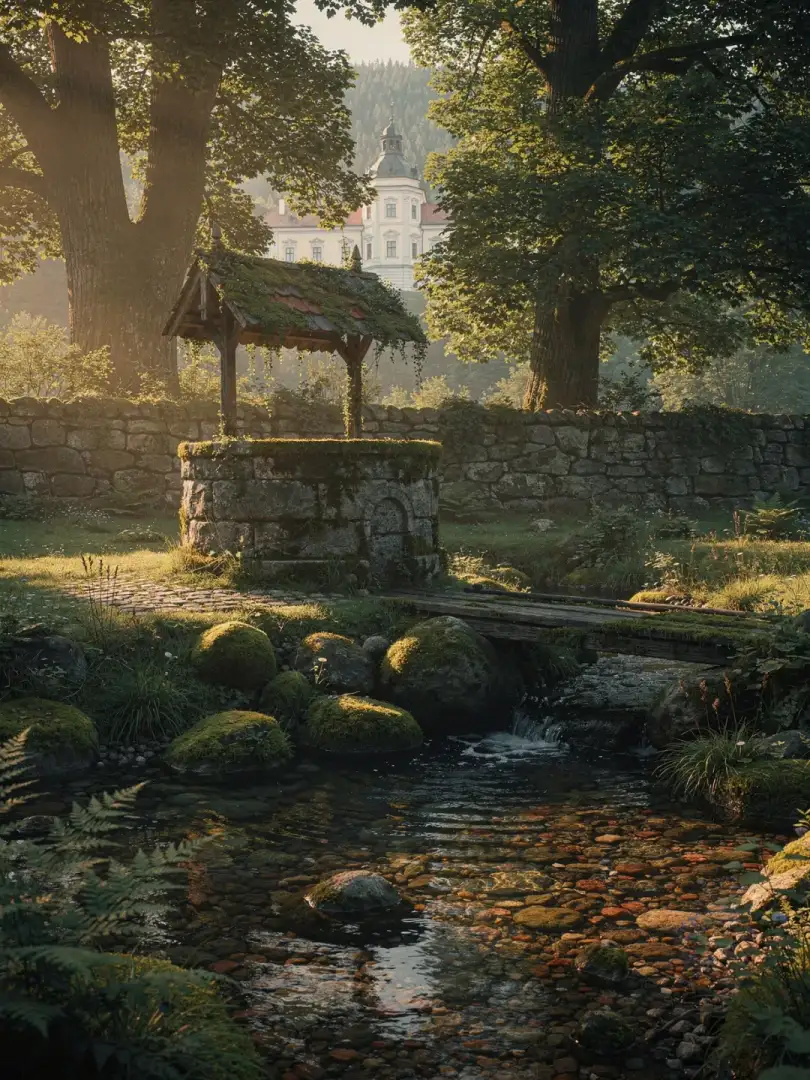
A Well in the Castle Park
Water & Soil
The water for Herold beer comes from the castle park in Březnice. According to the brewery, it draws from a well in the grounds of the château. A wooden pipe from a natural spring collector was later replaced with plastic piping, but the source itself—the park and its subsoil—remains unchanged.
Why does this matter for beer? Brewing water gives beer part of its character. Soft water, meaning water with few dissolved minerals, lets hop bitterness come through clean and straight. Hard water makes the same hop addition taste rougher. For pale Bohemian lagers, soft water is therefore considered an advantage.
Precise hardness figures for the wells at Březnice, Krušovice, or Velké Popovice aren't reliably known enough to cite. What is certain: today, nearly every brewery treats its water, removing hardness or adding salts as needed. The idea that style depends on the well alone no longer holds true in the 21st century.
Still, the landscape plays its part. Central Bohemia is a land of rolling hills, forests, and river valleys. Southwest of Prague rise the Brdy hills, a wooded range at whose edge Březnice sits. Around Rakovník and Křivoklát, where Krušovice calls home, large forested areas stretch out.
The cellars are part of the answer too. Beneath old brewhouses like the one in Březnice, whose buildings date from the Baroque era of 1722, the ground keeps the beer cool. Bottom-fermenting yeast works at low temperatures, and long aging rounds out the beer. Modern tanks have since taken over this job in many places.