Barley and the Kiln
Malt & Grain
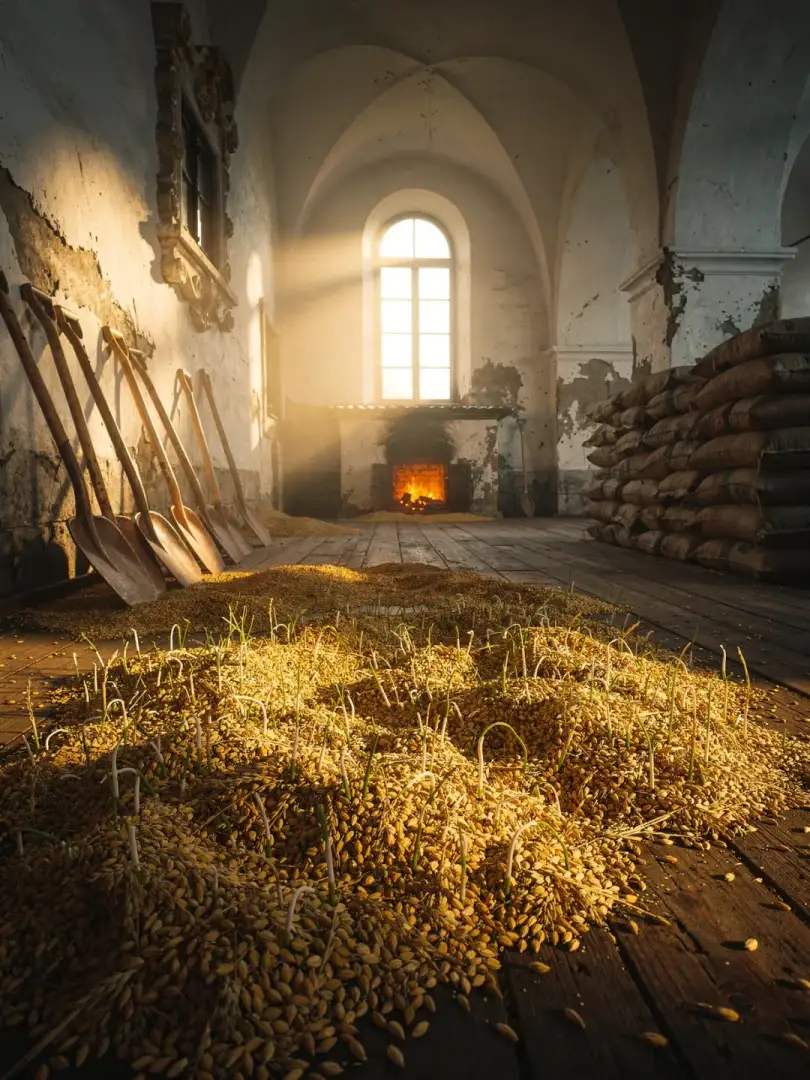
Where is malt made in Březnice? The brewery has its own malthouse, whose buildings date from 1722, just like the brewhouse, and are considered Baroque heritage monuments. Malt forms when barley is soaked in water and allowed to sprout until the grain can produce sugar, and the sprouting is then halted with warm air in the kiln.
The hotter and longer the kilning, the darker the malt becomes. Pale Pilsner malt stays light and tastes of fresh bread, while dark malt tastes of bread crust, cocoa, and caramel, because the sugar in the grain caramelizes. The number of color stages used in the brewhouse determines whether a lager pours golden-yellow or nearly black into the glass.
In Central Bohemia, all three major houses brew in several colors. Alongside its pale Ležák, Kozel produces a dark beer, Kozel Černý, and a blend of both called Řezaný. Krušovice likewise has a dark lager, Černé. Herold brews a 13- to 14-degree dark specialty beer in Březnice.
One particular curiosity is wheat beer: Herold in Březnice makes a wheat lager with twelve degrees original gravity. This is rare, since barley dominates in the Czech Republic. The Moravian landrace Haná is considered the ancestor of many Czech brewing barleys.
The degree number on Czech labels, 10° or 12°, refers to original gravity: it tells you how much malt sugar was dissolved in the wort before fermentation. Twelve degrees usually yields a beer around five percent alcohol, ten degrees one around four percent, since yeast converts the dissolved sugar into roughly equal parts alcohol and carbon dioxide.