Granite & the Elbe
Water & Soil
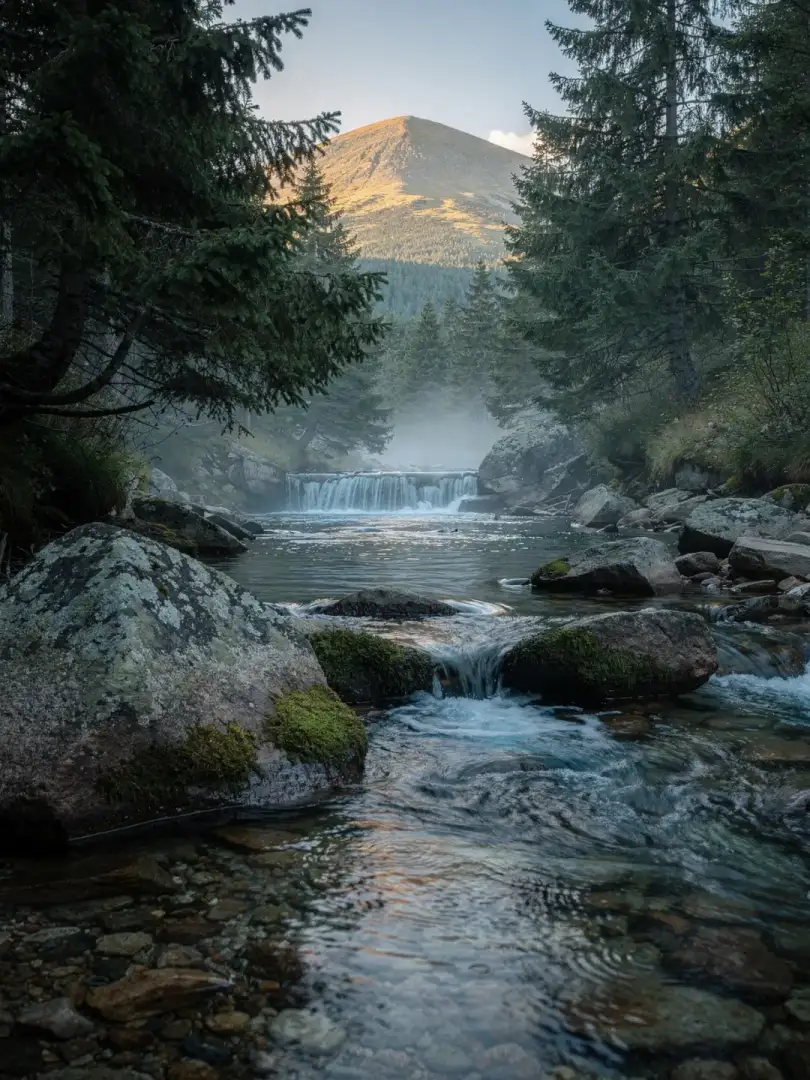
Where does Eastern Bohemia's brewing water come from? From the mountains that shape the region. The Giant Mountains, known in Czech as Krkonoše, boast the Snow Peak (Sněžka, 1,603 meters), the highest point in the Czech Republic, and this is also where the Elbe River has its source.
The rock there consists mainly of granite and mica schist. Such rock releases almost no lime into the seeping water, so spring water from the mountains is generally considered soft. Hardness describes the level of dissolved calcium and magnesium salts.
How does soft water affect beer? It makes the hop bitterness seem smoother, while very hard water makes it harsher. With dark beers, there's a second consideration. Roasted malt makes the mash—the mixture of crushed malt and warm water—more acidic, and the brewer adjusts the water accordingly.
In Humpolec, the Bernard brewery reportedly uses its own spring water from the Bohemian-Moravian Highlands. Pardubice, on the other hand, already lies in the Elbe lowlands, well below the mountain slopes, and according to the brewery, the porter matures there for about three months in the lagering cellar.
In the hinterland of Náchod rise the sandstone cliffs of Adršpach, a rock city of towers and narrow gorges. It's the same landscape that frames these beer towns: mountain, rock, river.
Today, nearly all breweries treat their water, softening it or adding specific salts as needed. The idea that water alone defines a style is thus more a matter of history than of present-day practice.