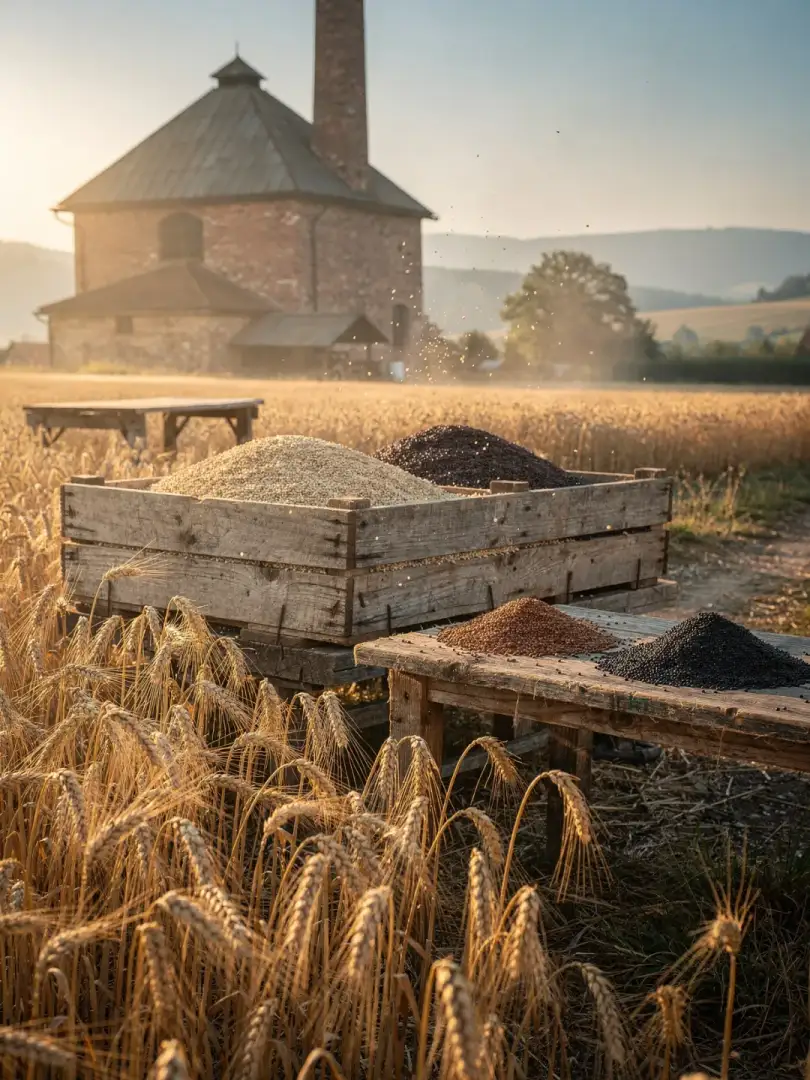
Four Malts
Malt & Grain
How does barley become malt? Maltsters let the grain germinate while moist so the starch inside dissolves, then dry it in a kiln with hot air. The longer and hotter the kilning, the darker and sweeter the malt becomes.
In Eastern Bohemia, this kilning stage determines the character of the beers. According to the brewery, Pardubický porter 19° is made from four malts: Czech malt, Munich malt from Bavaria, caramel malt, and color malt. Caramel malt provides the sweetness, color malt the near-black hue.
Munich malt is kilned to a medium degree and tastes of bread crust. It gives the porter a foundation on which the sweet and roasted notes can build. Without this base, the beer would taste cloying and flat.
The barley for Czech malt traditionally comes mainly from Moravia. According to its own account, the Bernard brewery in Humpolec uses Moravian malt for its beers, along with hops from Žatec.
Primátor's wheat beer from Náchod uses wheat malt, meaning germinated wheat. It contains more protein than barley, which supports the foam and gives the beer a fuller, softer body than a beer made purely from barley.
A single malt alone doesn't make a beer dark. The brewer blends varieties according to a recipe, and even small amounts of color malt are enough to turn an entire beer nearly black. Too much, though, makes it bitter and burnt-tasting. With porter, it's the blend that matters, not the quantity of any one variety.