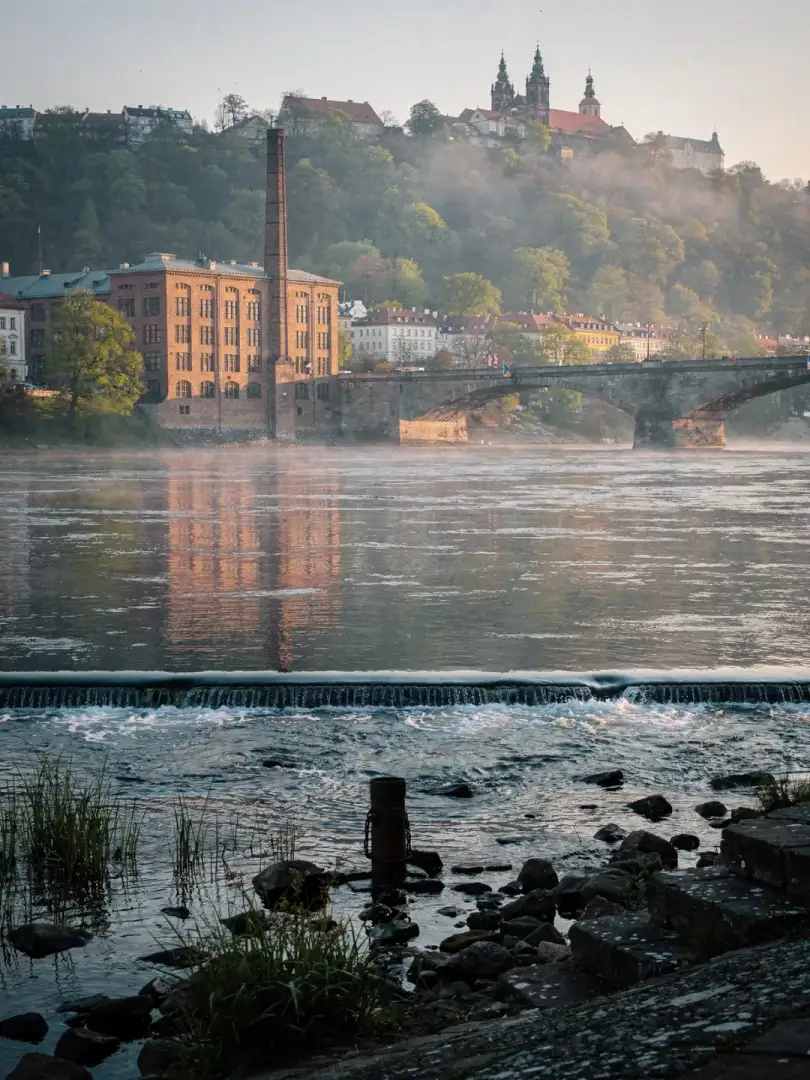
Vltava River, Hradčany Castle
Water & Soil
Prague lies in a valley basin through which the Vltava (the Moldau in German) flows in broad bends. On the terraces along its banks grew the districts of the Old Town and New Town, and on the slope above them, the Lesser Town and Strahov Monastery. Anyone wanting to build a brewery needed space for barrels, ice and water, and that was easiest to find near the river.
This fits the location of the Staropramen brewery in Smíchov, right on the river. In the 19th century, the river provided both a transport route and a source of cold: in winter, ice was cut to cool the lagering cellars. Without artificial refrigeration, bottom-fermented beer depended on this cold. Along the Vltava, that was a clear locational advantage.
How hard or soft does the water need to be? That depends on the beer. Soft, mineral-poor water lends a fine bitterness to a pale lager, as is characteristic of Pilsen. Dark malts, on the other hand, tolerate a bit more carbonate, meaning dissolved lime compounds that raise the acidity of the mash.
Today, almost all breweries treat their water, softening it or adding salts in a targeted way. This applies to large operations like Staropramen just as much as to small house breweries. Water therefore hardly shapes the style on its own anymore, but is instead adjusted to suit the desired beer.
What has remained is the cellar. The steep slopes below Strahov and the old houses of the New Town have vaulted cellars that stay cool even in summer. Barrels once matured in such spaces, and some pubs still display them today. The effect a cellar has on beer is felt above all in its stillness: cold, dark and almost without fluctuation.