Lángos and Ruin Bars
Food & Beer Culture
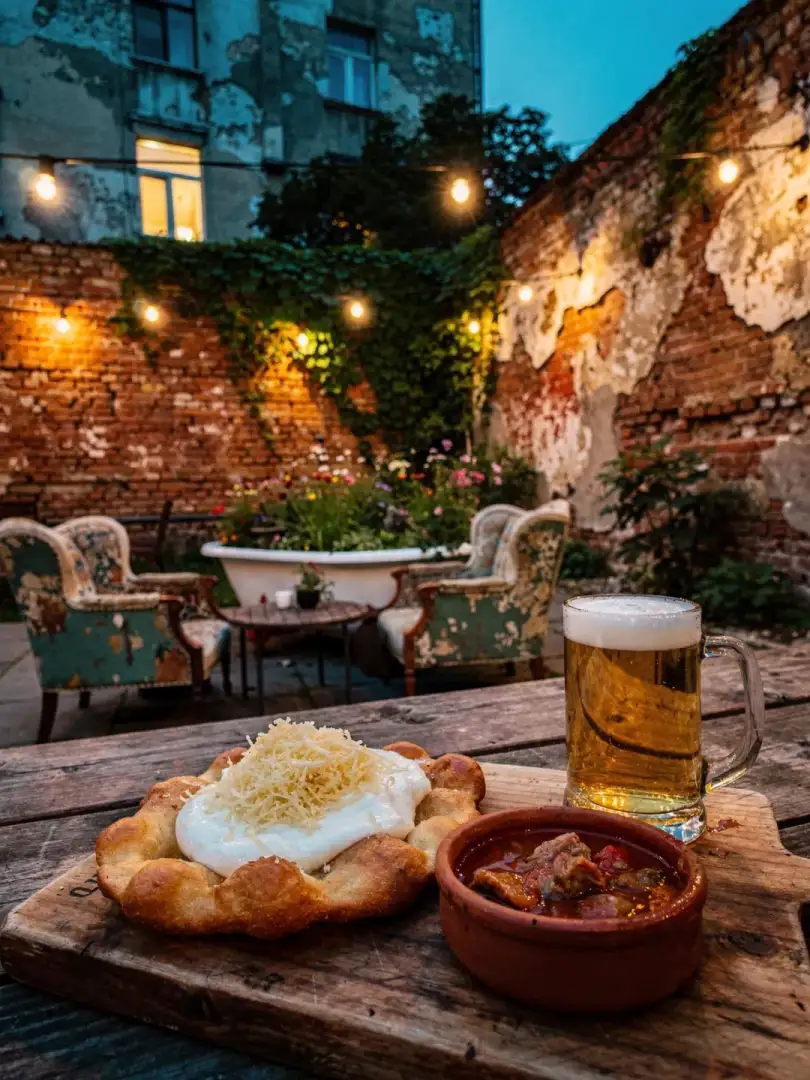
In Hungary, lager is the beer of choice with gulasch, pörkölt, and lángos. Lángos is a deep-fried flatbread served with sour cream and garlic, and the cool, lean beer cuts through the fat like dish soap. The same holds for pörkölt, a paprika-spiced meat stew, where the malt's sweetness tempers the heat.
A dish like gulyás is eaten in Hungary as a soup, not as a thick stew. The pale lager doesn't interfere with the paprika flavor here, but rather rinses the palate clean afterward.
The city's beer culture has, for the past twenty-odd years, included the romkocsma, or ruin bars. The term refers to pubs set up in crumbling buildings in the seventh district, which remained neglected for a long time after World War II and under socialism. Szimpla Kert opened in 2002 and moved in 2004 into a building complex on Kazinczy utca, where it still stands today.
There's one custom visitors should know about. Many Hungarians don't clink glasses with beer. Legend has it that Austrian officers toasted with beer in 1849 when thirteen Hungarian generals were executed in Arad, and Hungarians subsequently vowed not to clink beer glasses for 150 years. That period has long since passed, but many still observe the custom, though younger generations mostly don't. When sharing a table with Hungarians, it's best to simply raise your glass in greeting without clinking it against another, saying the Hungarian toast egészségedre, meaning "to your health."
In summer, people gather in the sörkert, the beer garden, in courtyards or on terraces along the river.