Korsó and Cool
Tasting
What does Hungarian beer taste like? The everyday lager is pale, cool, and lean, with a light malt sweetness and restrained bitterness. It's drunk more to quench thirst than to analyze, which makes it a great starting point.
Three factory beers represent the market. Dreher Classic comes from the Dreher house, owned by Asahi. Soproni comes from the brewery in Sopron near the Austrian border, dating back to 1895 and now owned by Heineken. Borsodi was first brewed in 1973 in Bőcs in northeastern Hungary and today belongs to Molson Coors.
As a counterpoint, there's the White Rabbit IPA from the small Budapest brewery Fehér Nyúl. It shows a markedly stronger hop character, golden color, and a bitterness that balances the malt, setting it clearly apart from everyday lager.
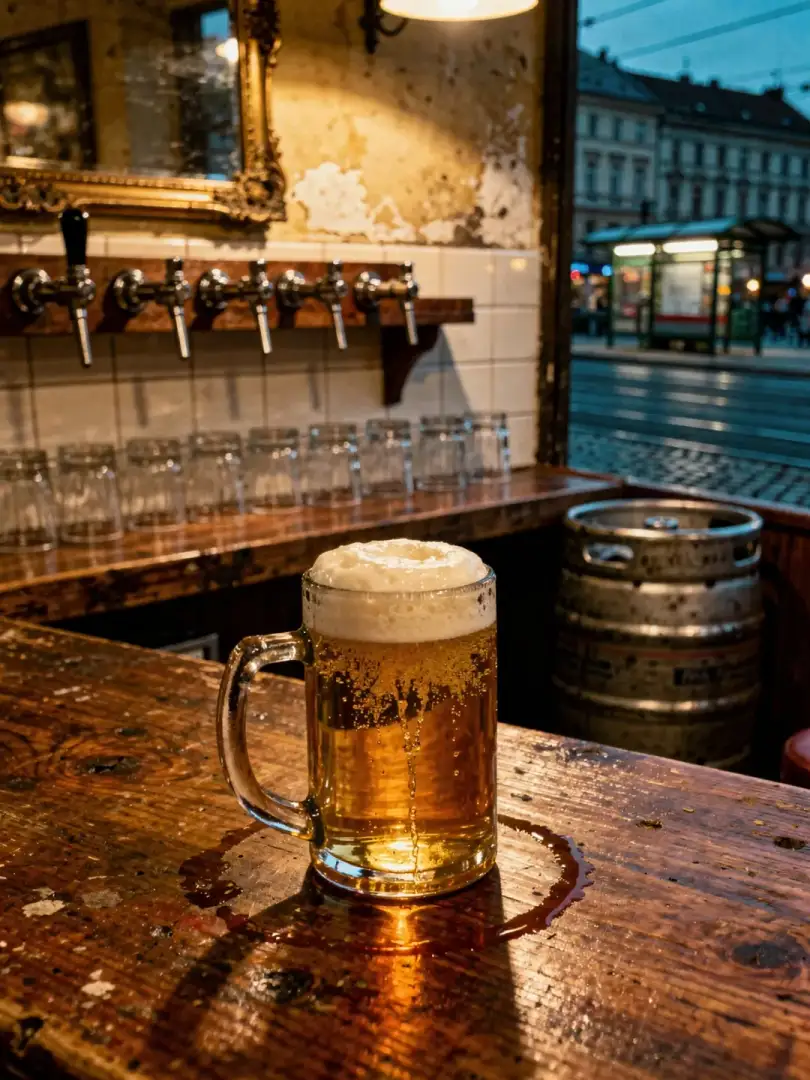
It's often served in a handled glass known in Hungarian as a korsó. It usually holds half a liter and keeps the beer cold longer. It's heavy, thick-walled, and sits comfortably in the hand, which suits a beer meant to be enjoyed without rushing. When pouring, the glass is tilted and the foam is allowed to rise only toward the end, right in the middle, to form a firm head. Hold the glass too upright and you'll get too little foam; hold it too flat and you'll end up with a mountain of foam displacing the beer—both can be avoided with a little practice.
The temperature stays low—well-chilled rather than ice-cold, since bitter cold makes the malt disappear.