Mountains, River, Flood
Water & Soil
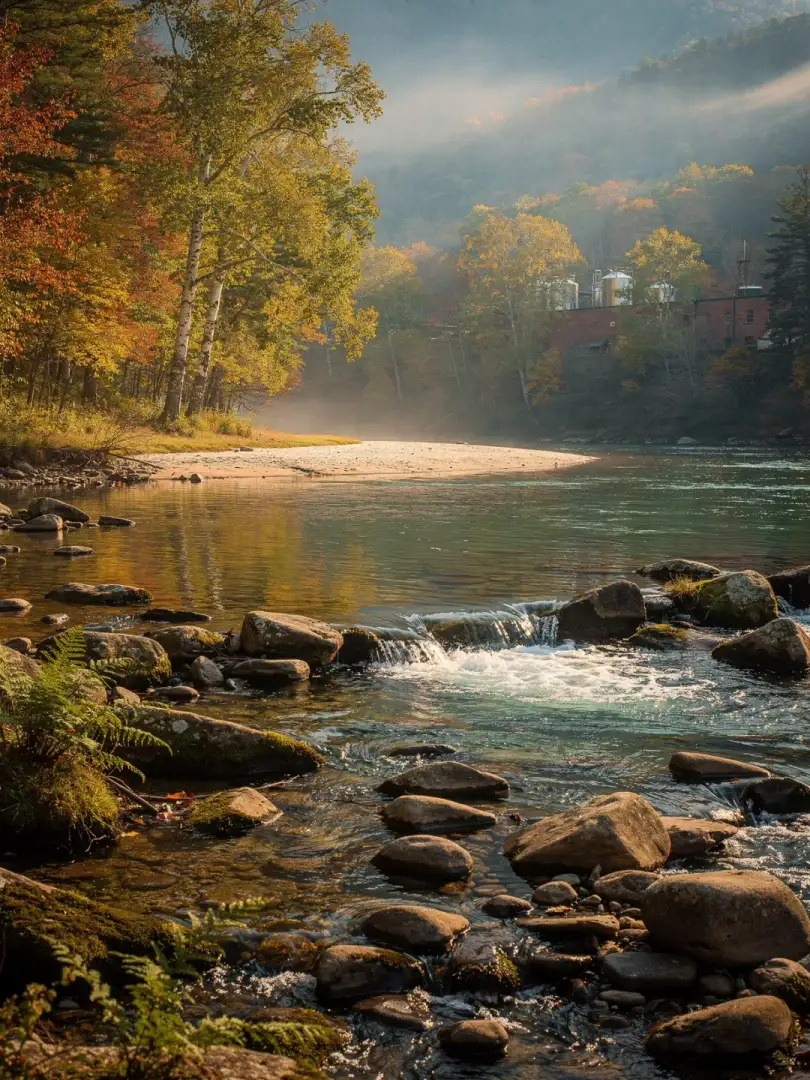
Where does the water for Asheville's beer come from? From the Blue Ridge Mountains, a range of the Appalachians that surrounds the city at an elevation of around 650 meters. Tourism sites praise the water as pure and well balanced in mineral content. Breweries rarely give exact hardness figures, and they wouldn't reveal much anyway.
That's because of a trend that holds almost everywhere now: today nearly every brewery treats its water. They soften it, filter it through reverse osmosis, or add specific salts. In the past, the source determined the style. Pilsen's very soft water suited pale, hop-forward pilsner, while Burton upon Trent's gypsum-rich water suited bitter English ales. A brewer in the mountains can recreate either profile.
For American pale ale and IPA, brewers often build a sulfate-forward water profile. Sulfate makes hop bitterness taste drier and sharper, while chloride makes a beer rounder and softer. Anyone after a hazy, juicy IPA usually takes the chloride route.
How much the city depends on its water became clear during Helene in September 2024. The municipal water system failed, and without water, no beer can be brewed. Highland Brewing lost its water supply. Hi-Wire Brewing in the River Arts District stood under roughly 4.5 meters of water; according to the company, about 1.3 million empty cans and 200,000 filled ones were lost, and the taproom stayed closed for nearly eight months. New Belgium reported up to 1.8 meters of water on the ground floor of the brewery; its taproom reopened on December 16, 2024.
Sierra Nevada's brewery in Mills River, south of Asheville, fared better. It was damaged but never flooded, and the taproom was back to normal hours about two weeks after the storm.