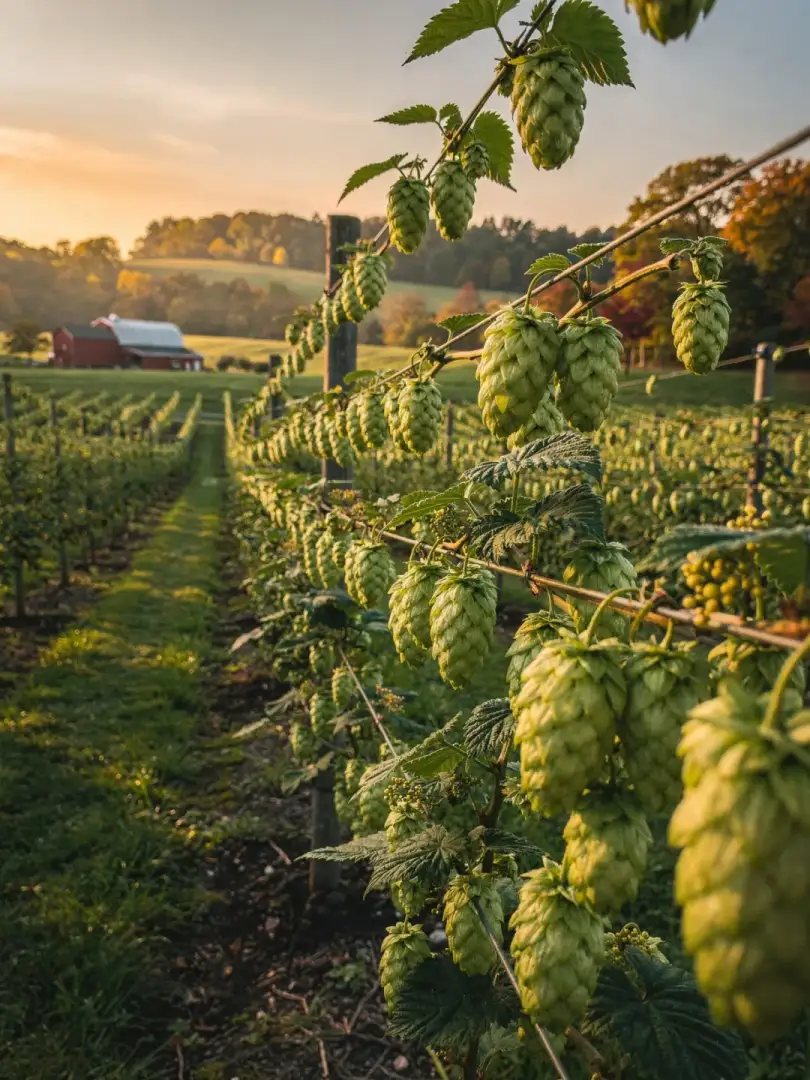
Noble Hops and Fruit Juice
Hops
Does hops grow in Massachusetts? For Boston's major beers, it comes from far away. In 2025 the US grew hops on 17,057 hectares and supplied around 40 percent of the world's alpha acid, the measure of bittering compounds, with a harvest of about 37,500 tons. The growing regions lie in the West, while breweries in the East buy their supply.
For Boston Lager, the brewery cites German noble hops, Hallertauer Mittelfrüh and Tettnanger. Noble hops carry little bittering power but deliver fine, floral, and spicy aromas. Both varieties come from regions that hold protected geographical indication status in the EU, Hallertau and Tettnang, both since 2010. That a Boston lager is brewed with Bavarian and Württemberg hops is a deliberate choice, one that follows European models.
How bitter is a Boston IPA? The style guideline for American IPA calls for 40 to 70 IBU, the unit measuring a beer's bitterness. Typical aromas include grapefruit, pine, and resin. Harpoon IPA, introduced by the brewery in 1993, is the best-known example here.
At Trillium and Tree House, it's a different story. The hops go in late in the process, in the whirlpool after the boil and again during dry hopping in the fermenter. This keeps plenty of aroma in the beer while leaving little bitterness behind.
That's why the Hazy IPA guideline sits at 25 to 60 IBU, and yet a hazy often tastes softer than a clear IPA with fewer bittering units. The aroma then leans toward orange, mango, or peach rather than resin.