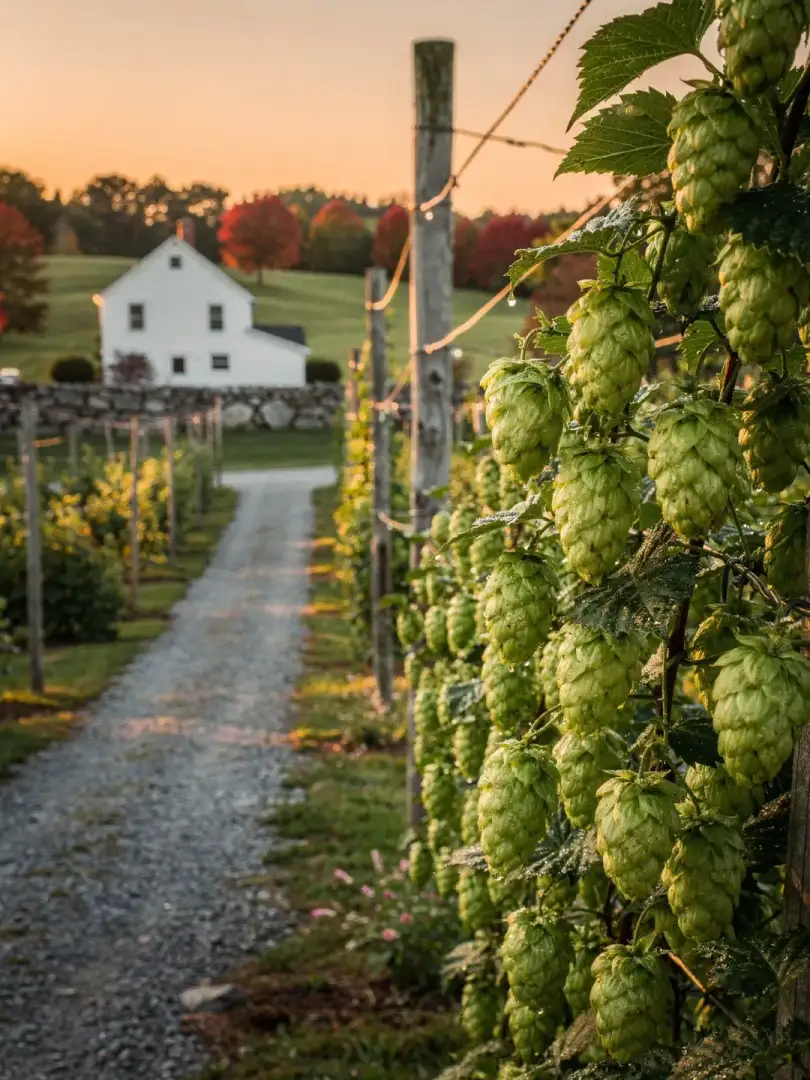
Young Hop Fields
Hops
Hops do grow in Maine, but not much. According to industry figures, less than one percent of the hops used by Maine's brewers come from within the state itself. Before Prohibition, Maine was considered one of the larger hop-growing regions in the US, but then the fields disappeared. Today, growers including Aroostook Hops in Westfield and The Hop Yard in Fort Fairfield and Gorham are cultivating hops once again.
Most hops come from the West. The US harvests across 17,057 hectares, accounting for around 40 percent of the world's alpha acid output in 2025. Alpha acid is the compound in hops responsible for bitterness. The major growing regions lie in the Yakima Valley, the Willamette Valley, and Idaho, supplying varieties like Cascade, Centennial, Citra, Mosaic, Simcoe, and Amarillo.
What role hops play in the glass depends on the style. In witbier, they stay in the background. The standard range is 8 to 20 IBU, the unit of measurement for bitterness. Spices matter more here. Allagash White, accordingly, leans deliberately on coriander and orange rather than hop aroma.
The thinking behind pale ale is quite different. For the American type, bitterness typically falls in the range of 30 to 50 IBU, and the hops bring citrus, pine, or floral notes to the beer. Geary's Pale Ale is considered an English-style example with pronounced hop character. Bitterness and aroma aren't the same thing: bitterness comes from the boil, while aroma comes from hops added late or during cold conditioning.
With Allagash's spontaneously fermented beers, hops play a third role entirely. In the Belgian lambic tradition, brewers use long-aged hops that have lost almost all their bitterness. Their job is to help preserve the wort without adding flavor. That's why the IBU range for lambic sits at just 0 to 10.