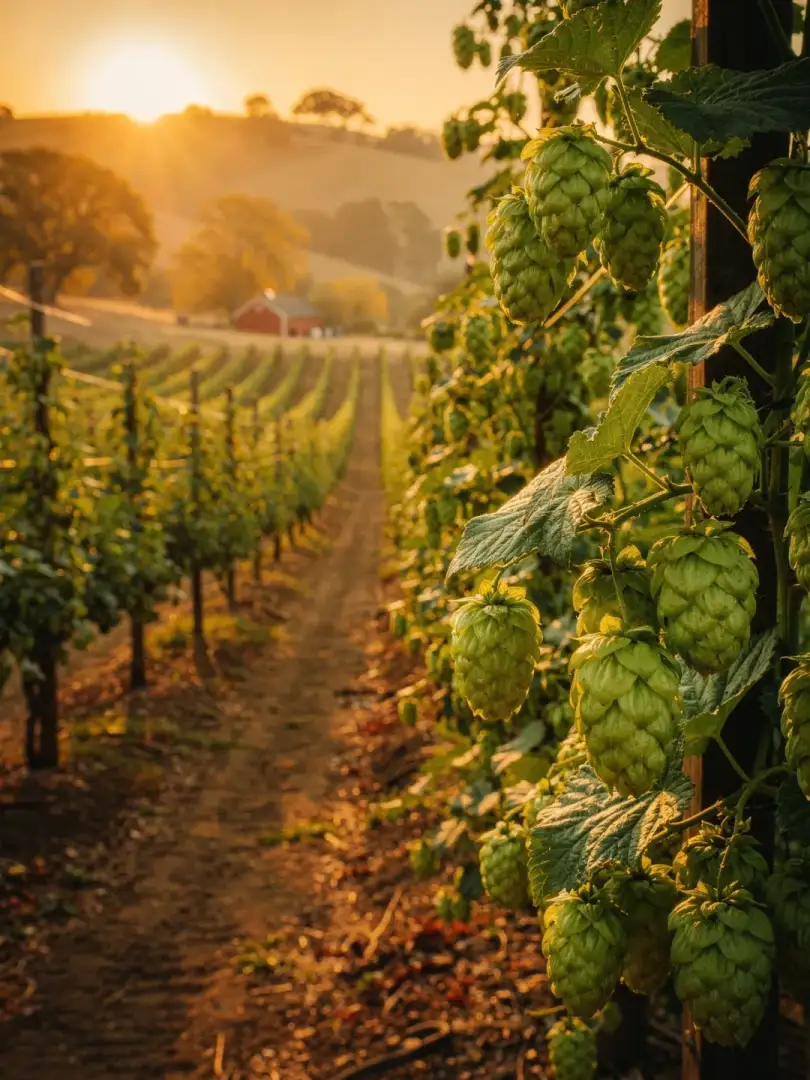
Cascade, Citra, Torpedo
Hops
Cascade, Centennial, Simcoe, Citra: these are the hop varieties behind the West Coast IPA. Cascade, on the market since 1972, defined Sierra Nevada Pale Ale and brings notes of grapefruit, floral tones, and pine. These varieties come out of American breeding programs and bring citrus, resin, and tropical fruit character to the glass.
Today, the hops used by Northern California brewers grow mainly in the Pacific Northwest. According to the 2025 BarthHaas report, the US cultivated 17,057 hectares of hops and supplied about 40 percent of the world's alpha acid output. Alpha acid is the compound in hops that converts into bittering compounds during the boil.
Bitterness and aroma come from different points in the brewing process. Hops boiled for a long time mainly contribute bitterness, measured in IBU. Hops added late in the boil, or even cold, deliver aroma instead. Adding hops cold is called dry hopping, and it's one of the defining traits of an IPA.
Sierra Nevada developed the Hop Torpedo for exactly this purpose—a stainless steel device that finished beer flows through to extract hop aroma without heat. At Russian River, hops are the star of the show: Pliny the Elder is considered the benchmark Double IPA. Its name references the Roman scholar Pliny the Elder, who is said to have described hops in his writings.
In Humboldt and Mendocino, the region's northern counties, another plant related to hops grows alongside it: cannabis. Both belong to the hemp family, and both carry their aroma in sticky resin glands.