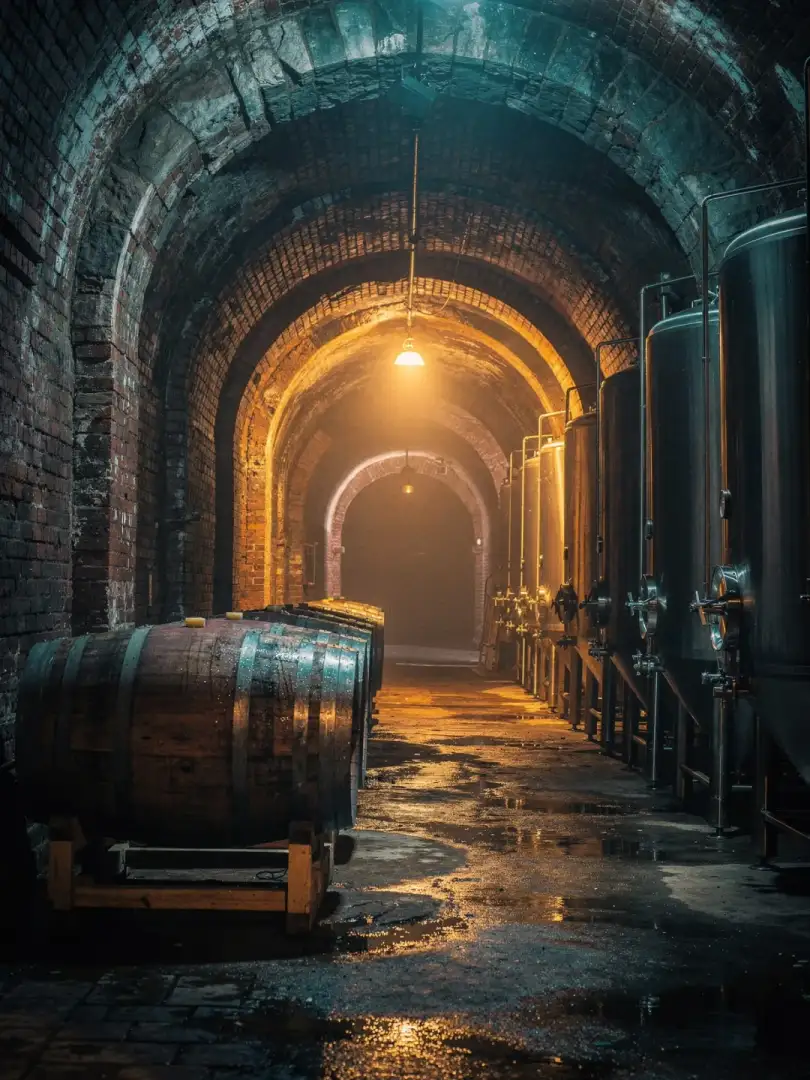
Cold in the Cellar
Yeast & Fermentation
Lager beer needs time and cold, and that was Cincinnati's real challenge. Lager yeast works at low temperatures and settles at the bottom of the fermenter, which is why it's called bottom-fermenting. Brewers had to maintain that cold even through summer, and that's why they dug the tunnels of Over-the-Rhine.
The yeast itself is a hybrid: Saccharomyces pastorianus arose from the crossing of two species, S. cerevisiae and S. eubayanus. It wasn't until 1883 that Emil Christian Hansen, at the Carlsberg Laboratory in Copenhagen, managed to isolate a pure culture of bottom-fermenting yeast. Before that, brewers simply passed their yeast from batch to batch without truly understanding it.
Lager fermentation typically takes place at around 8 to 13 degrees Celsius, followed by several weeks of lagering near freezing. In the 19th century, this aging happened in cellars; today it happens in refrigerated steel tanks. The beer clarifies during this process, and the flavor becomes smoother.
Burning River and Truth IPA, like any pale ale or IPA, are made with top-fermenting yeast, which works at room temperature, usually 18 to 22 degrees Celsius, and rises to the surface. Fermentation happens faster, and the yeast produces fruity aromas. Which yeast gets used depends entirely on the style.
The difference shows up in the glass: a cleanly fermented lager tastes crisp and dry, while an ale is allowed to smell of fruit. Both styles exist side by side in Ohio, reflecting the country's history. Lager came from Germany, ale from England, and 20th-century craft brewers brought the two together.