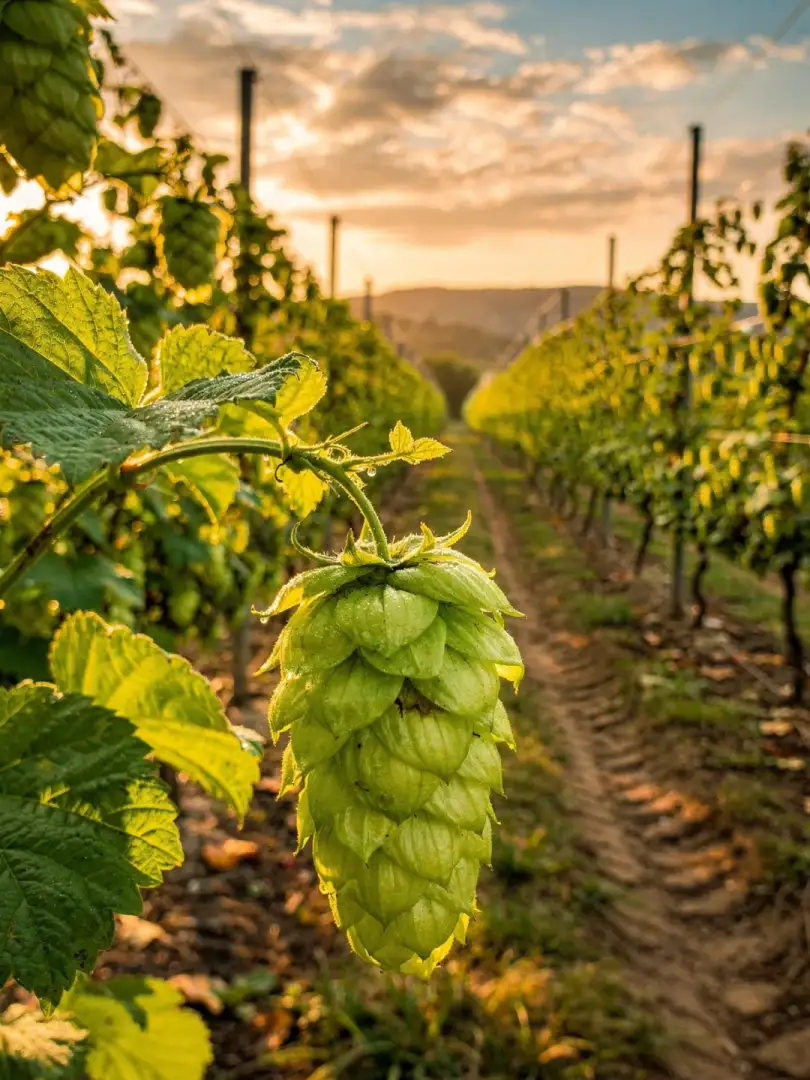
Cascade and Citra
Hops
Hops give beer its bitterness and aroma, and for Ohio they almost always come from far away. Ohio isn't one of the major hop-growing regions. In the US, those lie in the Northwest, in places like the Yakima Valley, the Willamette Valley, and Idaho.
In 2025, hop acreage across the US totaled 17,057 hectares, down from 18,513 hectares the year before. The country produces around 40 percent of the world's alpha acid output, with a harvest of roughly 37,500 tons. Germany reached 18,962 hectares in 2025.
Alpha acid is the bittering compound in hops. The more that ends up in the wort, the higher the IBU, the scale that measures bitterness. A Dortmunder Export stays around 20 to 30 IBU, while an American IPA can reach 40 to 70 IBU. That explains why the two beers taste so different, even though both are made from water, malt, hops, and yeast.
Classic American hop varieties include Cascade, introduced in 1972, along with Centennial, Citra, Mosaic, Simcoe, and Amarillo. They deliver aromas of citrus fruit and tropical fruit. Brewers typically add these hops late in the boil or even in the fermenter, so the aromatic compounds don't boil off.
Hops added early in the boil create bitterness; hops added late create aroma. In Rhinegeist's Truth IPA, hops take center stage; in Great Lakes' Dortmunder Gold, malt leads instead. In Cincinnati and Cleveland, brewers choose according to style: light and restrained for the lager, generous and late for the IPA. There's no single hop variety that defines the region.