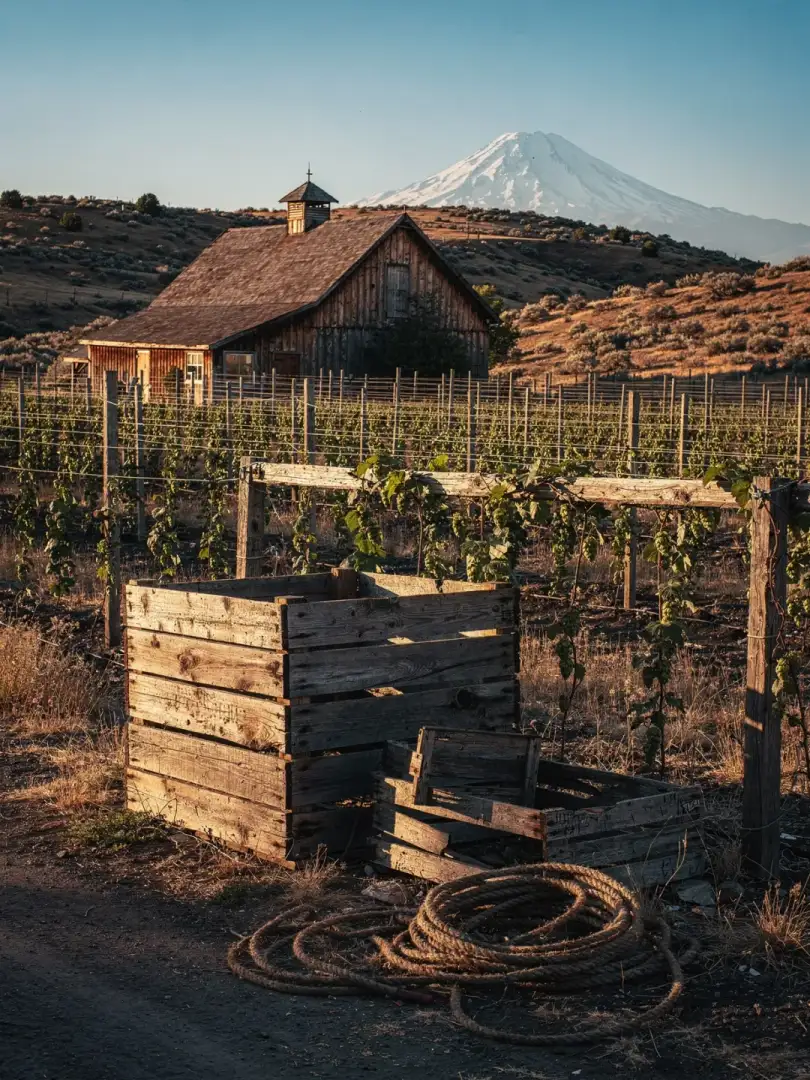
Hop Country in the Rain Shadow
Region & History
Where does most of America's hops grow? In the Yakima Valley in eastern Washington State, tucked into the rain shadow of the Cascade Mountains. According to the trade association USA Hops (Hop Growers of America), around three-quarters of America's hop acreage is located there.
The story begins in 1868, when Charles Carpenter settled south of present-day Yakima and planted his first hops, grown from cuttings taken from his father's farm in New York. By the 1880s, he had helped turn this dry valley into one of the most productive hop-growing regions anywhere.
The numbers tell you just how big this business is. According to USDA figures, Washington farms harvested about 29,000 tons of hops from roughly 13,500 hectares in 2024. For the entire US, the 2025 BarthHaas hop report cites a total area of 17,057 hectares, about 1,500 hectares less than the year before.
That decline comes down to market forces. Since 2023, hop supply has outpaced what breweries wanted to buy, partly because small craft breweries have been closing. In the US, "craft" means small and independently brewed.
The varieties that made this valley famous all trace back to breeding programs. Since 2003, the Hop Breeding Company has operated here, a joint venture between John I. Haas and Yakima Chief Ranches, an alliance of three farming families. These programs gave the world Citra, Mosaic, and Simcoe, names that are all trademarked. There is, however, no EU protected designation of origin for Yakima Valley hops.
Nowadays, brewers have set up shop right in the middle of the fields. Bale Breaker was founded in 2013 by siblings Meghann Quinn, Patrick Smith, and Kevin Smith, whose family has reportedly been growing hops in the valley since 1932.