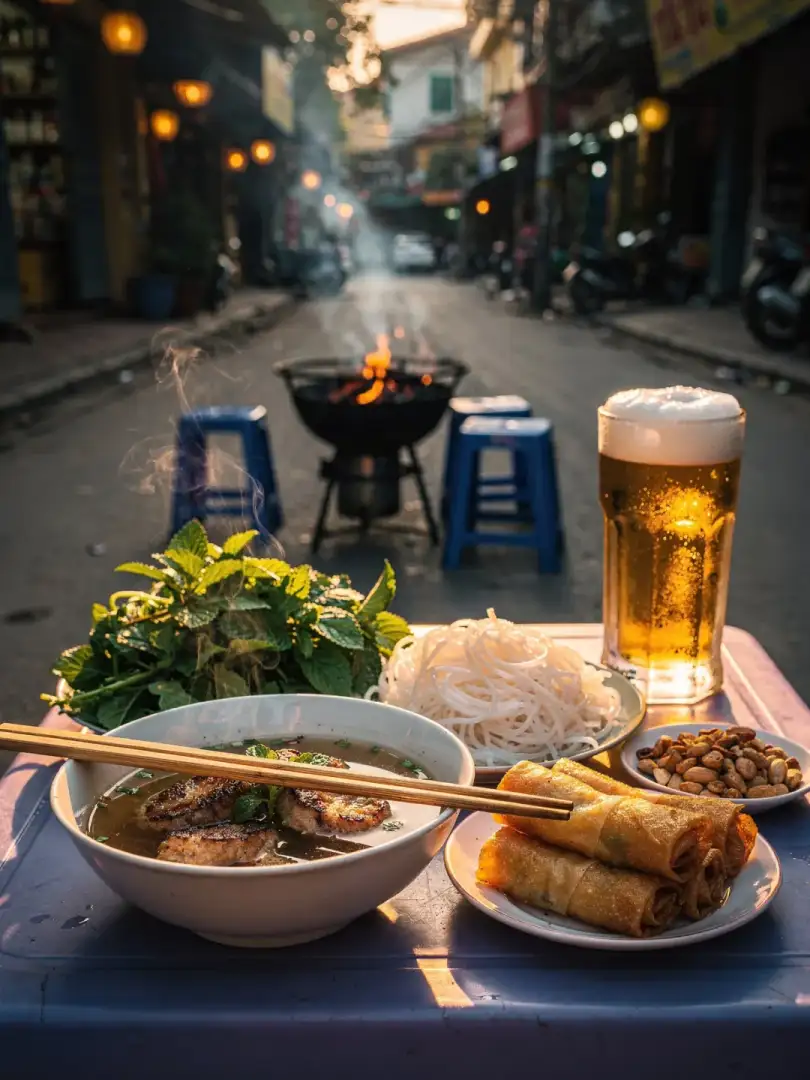
Bún chả, Stools
Food & Beer Culture
In Hà Nội, Bia hơi comes with a stretch of sidewalk. Guests sit on low plastic stools at low tables, often in the Old Quarter around Tạ Hiện street. Space is tight, noise is loud, and if you show up, you simply pull up a seat. The place feels more like a living room on the street than a proper bar.
The food follows the beer's lead. Nem rán, fried rice-paper rolls filled with minced meat and vegetables, is a classic of the capital. Alongside come peanuts, lạc rang in Vietnamese, and fried tofu, đậu phụ rán. The beer is light and cool, cutting through the spice and the frying oil without weighing down the palate.
Bún chả is the city's best-known dish: grilled pork and meatballs in a sweet-and-sour broth, served with rice noodles and herbs. It's usually eaten at lunchtime. In 2016, Barack Obama and Anthony Bourdain ate Bún chả in Hà Nội and drank bottled Bia Hà Nội with it. The beer tastes clean and light alongside it, cutting through the smoke of the grill.
When toasting in Vietnam, people call out 'Một, hai, ba, dô!' — 'One, two, three, up!' Everyone clinks glasses together, and often one round follows another. Because Bia hơi is low in alcohol, the evening stretches on, but the beer stays a light drink throughout, never a contest.
Anyone drinking Bia hơi should treat alcohol with moderation, as everywhere else. Here, beer is a companion to food and conversation, and the appeal lies not in the quantity but in the freshness and the company on the sidewalks of Hà Nội.