Lightly Hopped
Hops
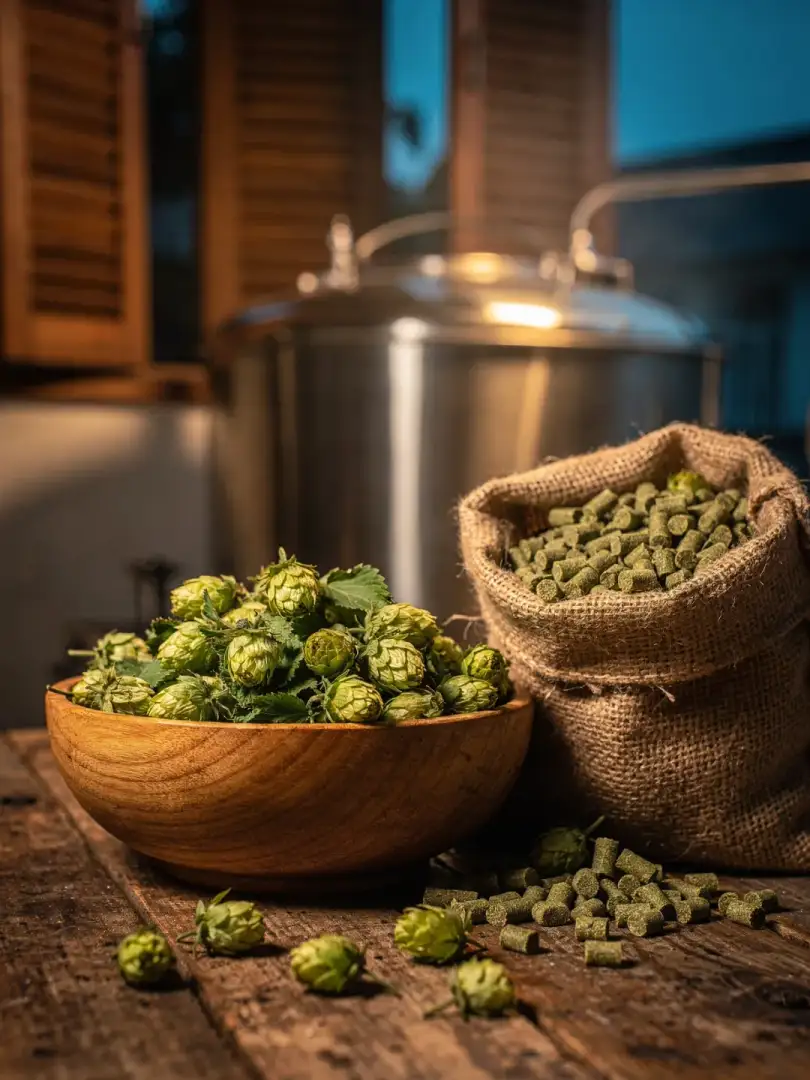
Hops like cool summers and long days, and in the tropics they don't find what they need. Vietnam therefore has practically no hop cultivation, and breweries source their cones from other countries. They're usually processed as pellets, pressed hop cones, or as extract, a concentrated form.
Hops contribute two things to the wort. The bittering compounds, the alpha acids, only develop during the boil and keep the beer in balance — otherwise the malt sweetness would feel cloying. The aroma oils, on the other hand, evaporate during long boiling, which is why aroma hops are added late.
Bitterness is measured in IBU, International Bittering Units. Strong Pilsners sit at around 30 to 45 by European standards, while a mild American lager is around 8 to 18. Bia hơi, by taste and feel, leans toward the milder side — there are no exact figures for Bia hơi, since there's no standard for it.
Bitterness is secondary here, and for good reason. Anyone drinking several glasses in the heat doesn't want a beer that clings to the palate or lingers too long. The light hopping keeps the flavor short and clean, similar to a light beer.
So at Habeco too, the formula holds: hops are imported, dosing is mild, and variety choice is up to the brewery. Anyone comparing a Bia hơi with a German Pils will notice the difference fastest in the bitterness.