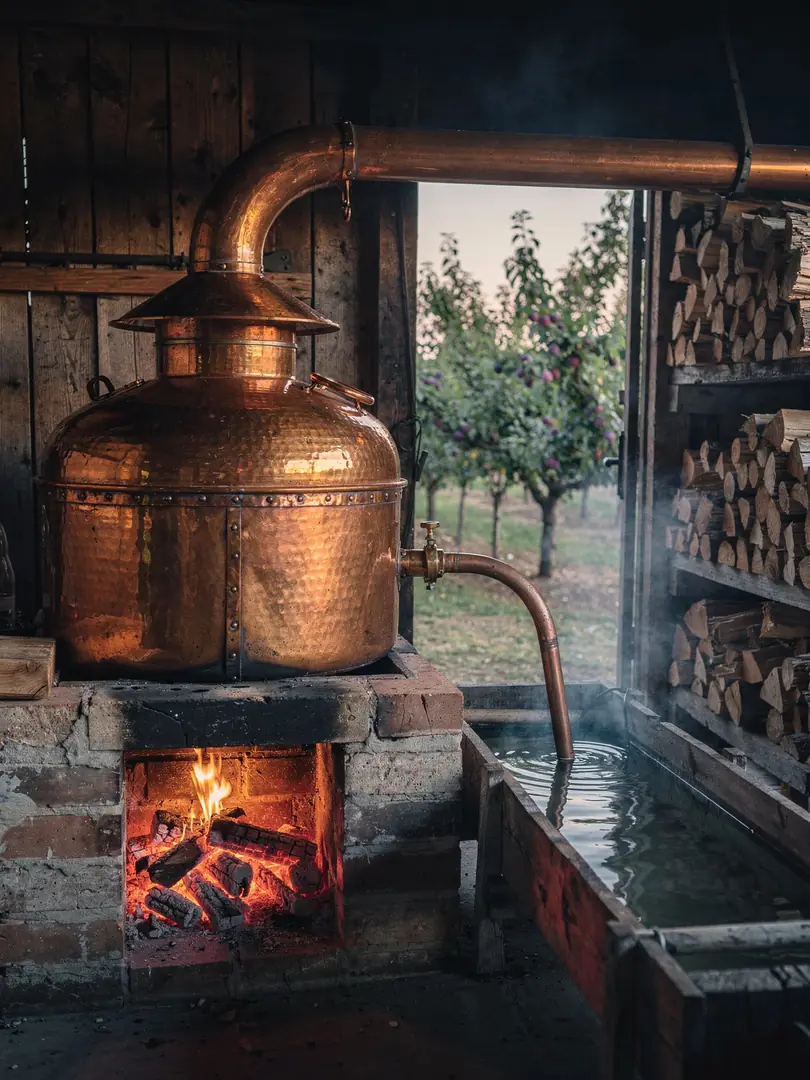
Copper Still Kazan
Distillation
What is a kazan? It's the copper still in which the mash is heated. According to UNESCO's description, these are handcrafted copper stills, and the craft of making them is passed down in dedicated workshops. Copper isn't used by chance: the metal binds sulfur compounds and keeps them out of the distillate.
The principle is simple. The mash is heated from below, and since alcohol evaporates before water does, it rises into the still's head, turns back into liquid in a cooled pipe, and drips out as distillate. In the second run, the alcohol already contained in the first distillate is separated out again, making the brandy clearer and purer.
UNESCO describes two distillation runs: the first distillate is mild, while a second distillation makes the brandy stronger. In Serbia, a twice-distilled brandy is called prepečenica, usually around 40 to 45 percent alcohol. How many times a brandy is distilled depends on the producer and the desired style. For Šljivovica from western Serbia, this is the usual approach.
During distillation, the distiller separates the output into fractions. The heads come first, smelling sharp and containing volatile substances that shouldn't end up in the bottle. Next comes the heart, the true essence, where the plum character shows most clearly. The tails come last and taste dull and harsh.
Important to know: the heads cut only partially reduces methanol, since it's already present in the mash. Commercial producers who want to sell within the EU must therefore stay within the legal limits.
In the end, what matters on the label is the drinking strength: the distillate is diluted with water to reach the strength stated on the bottle. This is standard practice and perfectly legal.