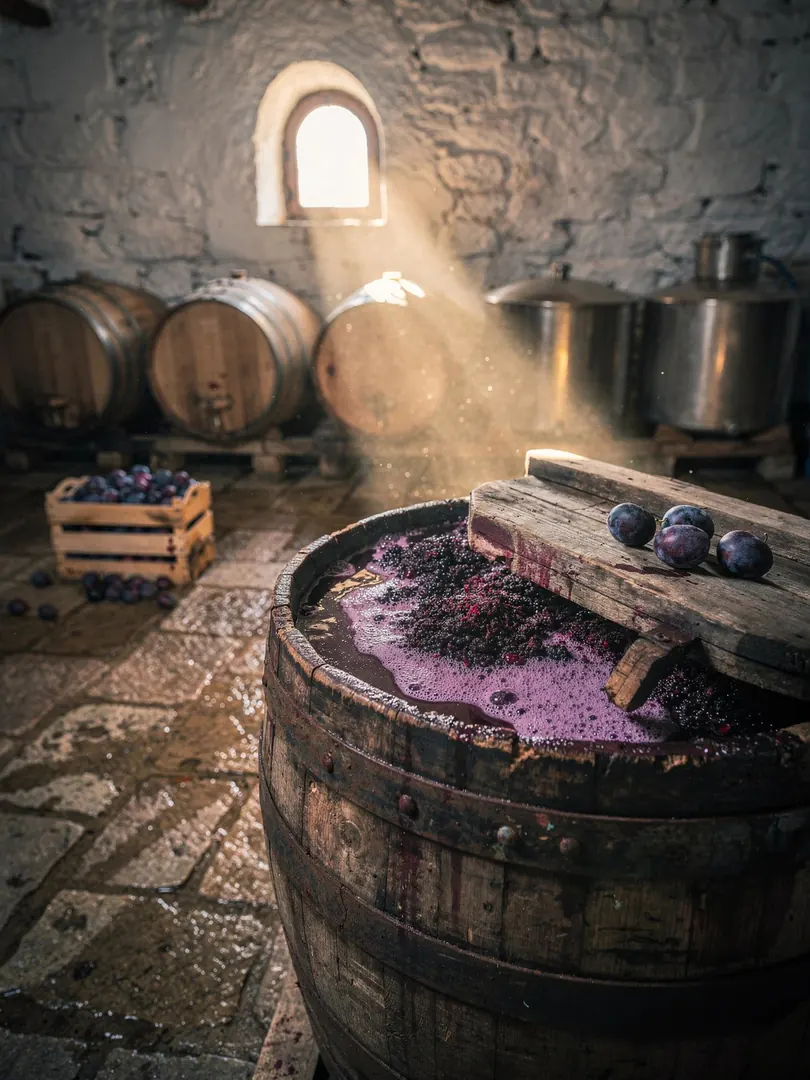
Fermentation in the Barrel
Mash & Fermentation
How is the mash for Šljivovica made from plums? First, the fruit is crushed until a thick pulp forms, in which juice, flesh, and skins mix together. The pits are kept as whole as possible, since crushed pits release hydrogen cyanide. This applies to Požegača and Crvena ranka just as it does to any other variety.
This pulp goes into barrels or tanks that are sealed off from air. What matters is an airlock that lets gas escape but keeps air out. From this point on, yeast gets to work: it consumes the fruit sugar and turns it into alcohol and carbon dioxide. Some producers rely on the wild yeast already present on the skins, while others add cultivated yeast.
According to UNESCO's description, the mash ferments for 20 to 30 days. During this time, a crust of skins rises to the top, the mixture foams, and the air fills with the scent of ripe plums and yeast. In cooler conditions, fermentation proceeds more slowly; in a warm cellar, it's faster—both affect the resulting aromas. Whether the mash is stirred during this process depends on the producer.
By the end, the mash contains only a few percent alcohol by volume, but it already smells distinctly of plum brandy. At this point, cleanliness is crucial. Mash that has turned sour, developed a vinegar tang, or grown mold won't disappear in the still—it will carry over into the distillate as an off-note. That's why the mash is distilled promptly once fermentation is complete.
This is also where methanol originates. It forms from the fruit's pectin already during fermentation, not during distillation itself, which is why it's present in every fruit brandy. It becomes dangerous only in adulterated alcohol, not in a brandy that stays within the legal limits. In the EU, this limit for plum brandy is 1,200 grams per hectoliter of pure alcohol.