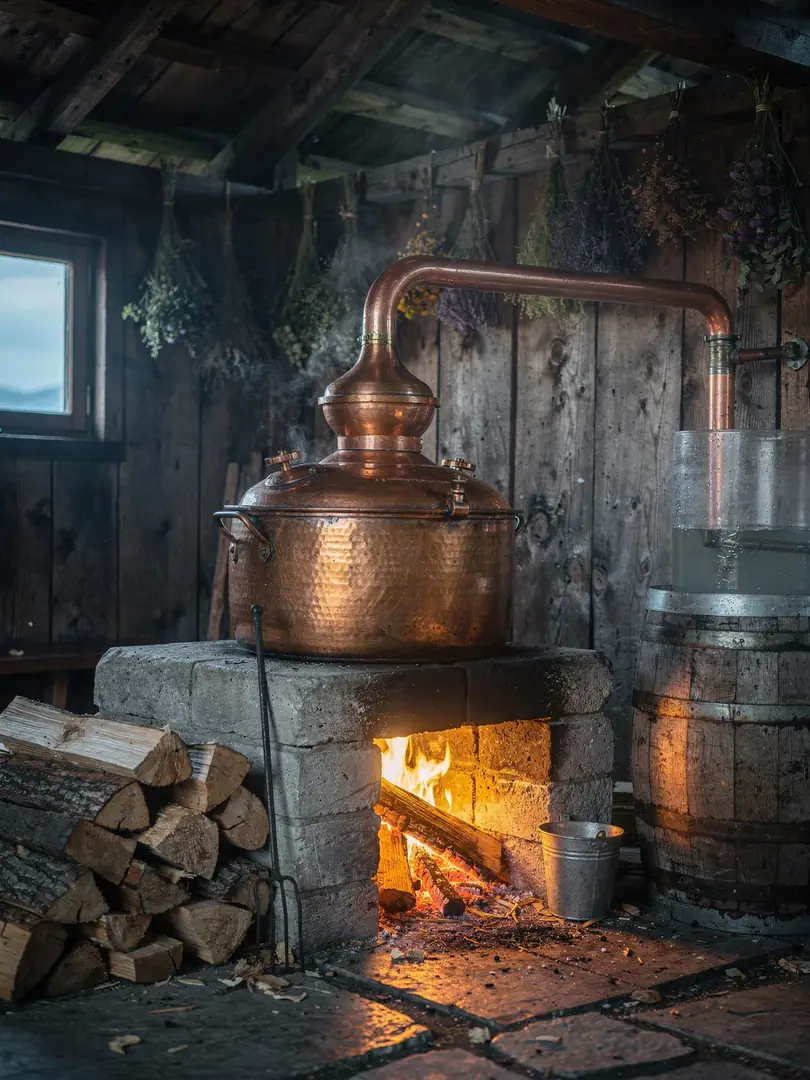
Copper Stills Over an Open Fire
Distillation
The still is called a cazan in Romanian and is made of copper. According to the description of Horincă and Romanian standards, it's heated over an open fire, usually with wood, sometimes with charcoal. Open fire gives the distiller little room for fine control, since the heat is slow to adjust. Copper binds unwanted sulfur compounds and gives the spirit a clean, fruit-forward character.
Classic Țuică is distilled once and leaves the still at a mild strength. According to its description, Țuică de Argeș uses a still that completes a short, single-stage distillation. When distilled twice, a stronger spirit results, sometimes called Pălincă de prune in certain regions, reaching roughly 50 to 65% ABV. According to its description, Horincă de Cămârzana is distilled and then redistilled.
Whether distilled once or twice, the distiller divides the run into three parts. The heads come first and smell of solvent, since volatile compounds like acetaldehyde and ethyl acetate emerge early. These are cut away. The heart carries the aroma and goes into the bottle. The tails bring heavy, fusel-laden compounds and are likewise cut, often redistilled separately.
For Vinars, EU rules for wine distillates apply: the spirit must stay below 86% ABV so the wine's aroma survives distillation. A neutral, odorless alcohol only forms at higher strength, which would defeat the purpose as a base spirit.
What seems self-evident in Romanian villages is illegal without a permit in Germany. The point here is the principle, not a how-to guide. Even there, how clean a spirit turns out depends on the distiller's experience, who must learn to smell the exact moment the heads give way to the heart.