Pulp Becomes Alcohol
Mash & Fermentation
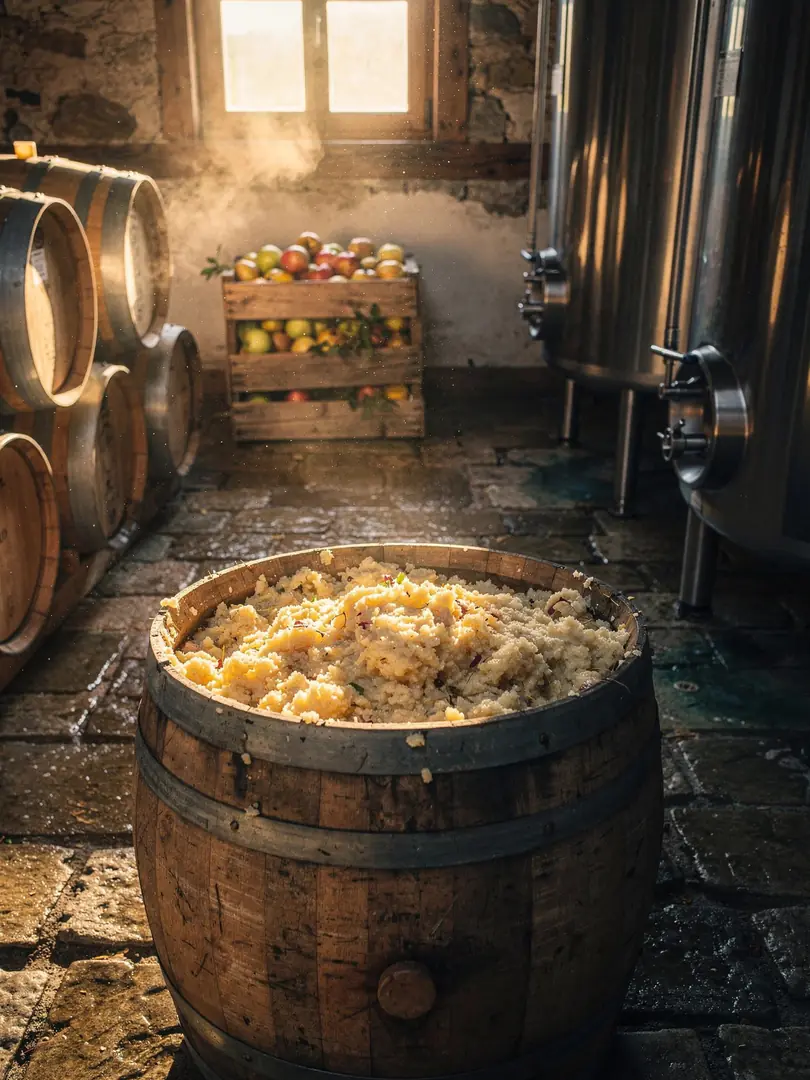
Fruit only becomes spirit once yeast has fermented the fruit's sugar into alcohol. Before that comes the fruit mill: at Lake Constance, apples and pears arrive as fresh as possible, since they start to spoil quickly, and the mill crushes them into a pulp known as the mash.
The mash goes into barrels or stainless steel tanks, which are easy to clean. For an Obstler, the apples and pears typically come from different varieties and usually from different batches as well. Some distillers ferment the fruits separately and blend them later, while others combine everything in a single vessel. A Williams, by contrast, is made only from Williams Christ pears and fermented on its own.
The yeast can come from the fruit itself, but many distillers add cultivated yeast strains instead, since fermentation then runs more predictably. What matters is that the vessel stays airtight, with only the carbon dioxide produced able to escape through a fermentation lock. If air gets in, acetic acid bacteria turn the alcohol into vinegar, ruining the mash.
Fermentation takes a few weeks, and cool temperatures keep it steady. Once fully fermented, the mash doesn't keep for long, so distilling follows promptly. Anyone who tastes it beforehand will find a sour, slightly cloudy liquid that bears little resemblance to spirit yet.
Methanol already forms during fermentation. It comes from pectin, the substance that holds the fruit's cell walls together, not from any mistake in distilling. Every fruit spirit therefore contains some. EU law sets maximum limits, and for Williams pears the limit is highest at 1,350 grams per hectoliter of pure alcohol, while for apples and other pears it stands at 1,200.