Copper and Patience
Distilling
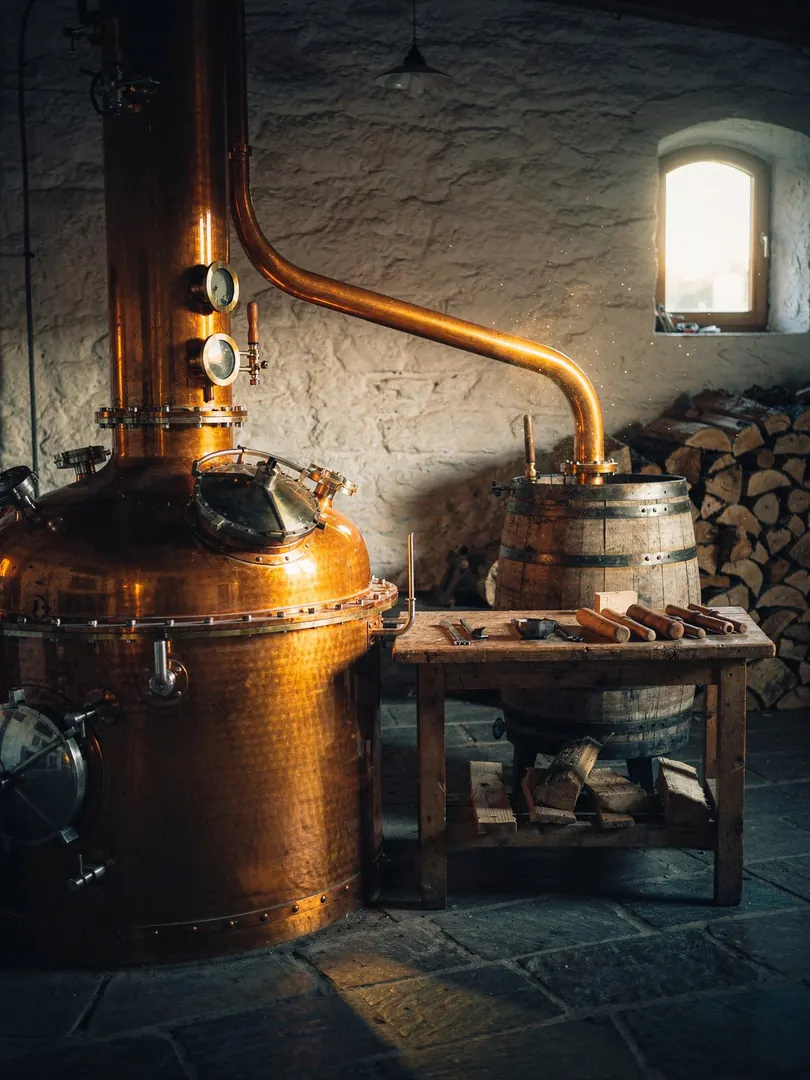
In the still house of a farm somewhere between the Kocher and the Jagst stands a copper pot, heat beneath it, and above it a head that channels the rising vapors into a pipe. Copper conducts heat well and has long been the material of choice for distilleries, in Hohenlohe as elsewhere.
The principle is simple. Alcohol boils at a lower temperature than water. As the distiller heats the mash, alcohol-rich vapors rise first and condense back into liquid in the cooler. Depending on the setup, this happens twice, with an intermediate product in between, or once using an attached rectifying column. The column separates the finer fractions from the heavier ones as the vapor rises. Every distillation run must stay below 86% ABV.
The crucial part is the cut. First comes the heads, volatile and sharp-smelling, which are separated out. Then comes the heart, the main portion. Finally comes the tails, heavy and slightly bitter, which the distiller also separates. Methanol levels drop only partially when the heads are cut, since methanol is distributed throughout the entire run.
In an Abfindung distillery, the alcohol isn't measured directly but calculated as a flat rate from the quantity of raw material and an official yield rate, hence the name. Distilling is only permitted with a license, and anyone distilling without one is breaking the law.
The name Birnenwasser is a bit misleading. Water is only added at the end, when the brandy is diluted to drinking strength. Hohenloher Birnenbrand must reach at least 38% ABV in the bottle, half a percentage point above the EU minimum of 37.5% ABV for fruit brandy.