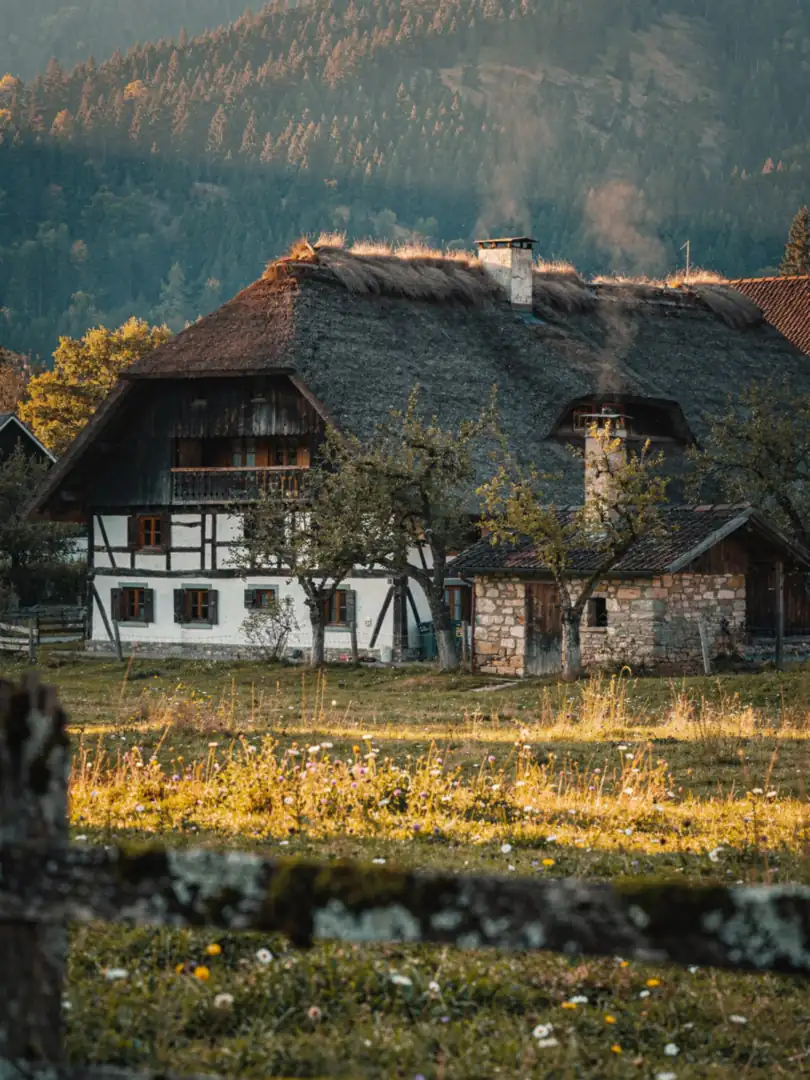
Farms on the Hillside
Region & History
Driving up the Kinzig Valley near Haslach, you'll spot Black Forest farmhouses perched high on the slopes, each with its own orchard and some with a small distilling house, or Brennhäusle, next to the bakehouse. In the mid-Black Forest, distilling was rarely done for the city market. People distilled because fruit and tubers were left over, and a farm had to make the most of everything it produced.
As almost everywhere, the knowledge came from monasteries and apothecaries, where "aqua vitae" was distilled as medicine in the Middle Ages. Farmers later adopted it for their windfall fruit. The open-air Vogtsbauernhof Museum in Gutach shows exactly what such a farm and its outbuildings looked like: the main house dates to 1612, and among the outbuildings is a bakehouse with a distillery attached.
So how is farm distilling regulated today? The path runs through the Abfindungsbrennerei, or allowance distillery. A farm with at least 3 hectares — or 1.5 hectares for intensive fruit growing or vineyards — may distill up to 300 liters of pure alcohol per year with permission from the main customs office. The amount isn't measured directly but calculated from the raw material using official yield rates. That's where the term "Abfindung" (allowance) comes from.
Until December 31, 2017, this right was tied to the farm itself, governed by the spirits monopoly. Since 2018, the Alcohol Tax Act applies, and the permit is now tied to a person rather than a property. Anyone inheriting a farm must reapply within three months, and processing has sometimes taken over a year. Those without their own still but with their own fruit can have up to 50 liters of pure alcohol distilled annually at someone else's allowance distillery, as a so-called Stoffbesitzer (material owner).
Is it legal to distill schnapps purely for personal use? No — even for personal consumption, this permit is required. The often-cited two-liter limit simply marks the point at which a still must be registered. Nationwide, 10,931 allowance distilleries were still operating in 2023. Rossler has no protected designation in the EU register, even though it's considered a Badenese specialty, while certain Black Forest fruit brandies do hold such status.