Farm Fruit and Tubers
Fruit & Raw Material
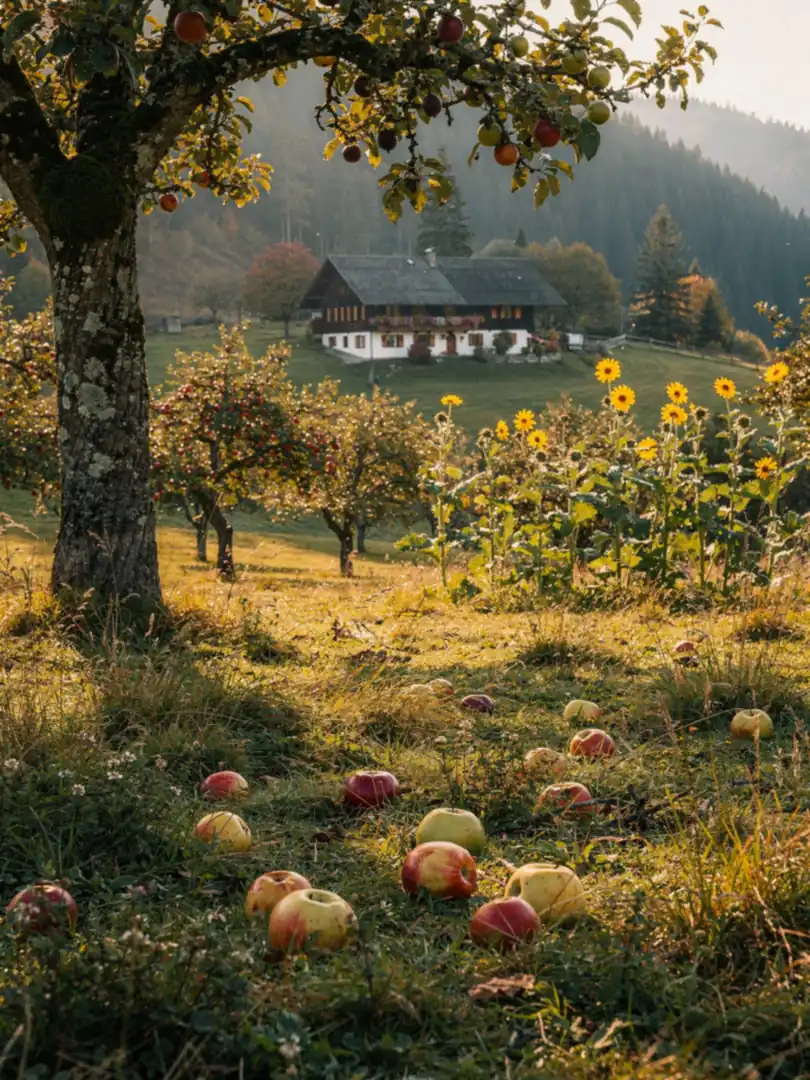
Around the farms stand tall standard trees bearing apples and pears, interspersed with plum trees whose fruit never needs to meet any trade grade. Windfall fruit, small fruits, and anything too soft to store ends up in the mash. The scattered orchard trees on the hillside thus supply the raw material for Obstler.
What exactly is an Obstler? It's a fruit brandy in which at least 85 percent of the mash comes from apples, pears, or both. Up to 15 percent may be other fruits — there's no requirement for 100 percent apple. That's precisely why every farm's Obstler tastes a little different, depending on what happened to be hanging on the trees that autumn.
In some fields in the valley, something quite different grows: Jerusalem artichoke, a type of sunflower that blooms yellow in late summer and can reach up to three meters tall. Underground, it forms tubers that look like knobby potatoes. It's considered undemanding and thrives even where the soil is too poor for grain.
Instead of storing starch, the tubers store inulin, a long chain of fruit sugar. Yeast can't ferment it directly — the chain must first be broken down. This fundamentally sets Rossler apart from a fruit brandy: here, it's not fruit flesh that ferments, but a root vegetable.
The name Rossler is usually explained by the fact that the tubers were once fed to horses ("Rösser" in the local dialect), hence also the term "Ross-Kartoffel" (horse potato). Other names for the plant include Erdbirne (earth pear) and Topinambur. The EU classifies spirit drinks from Jerusalem artichoke as their own category 14, with a minimum strength of 38% ABV, and allowance distilleries are explicitly permitted to process these tubers.