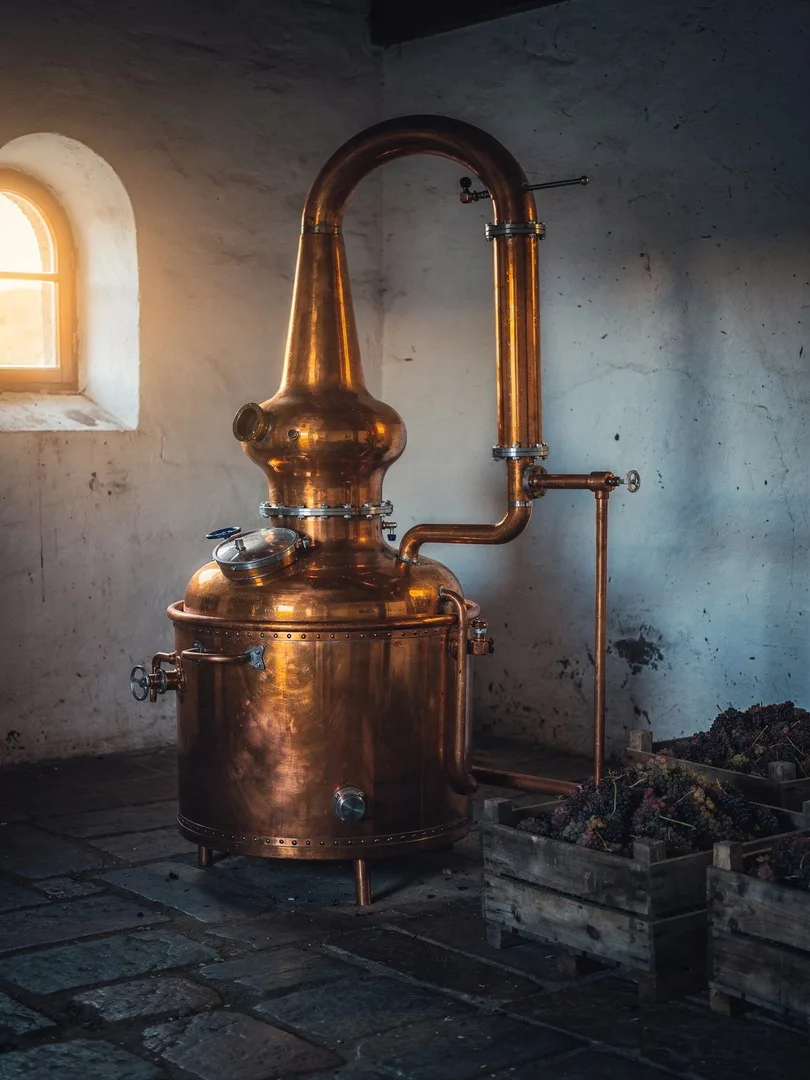
Pomace in the Still
Distilling
What's special about distilling pomace? EU spirits regulations require that pomace brandy be distilled the first time with the pomace itself. The distillate must not exceed 86 percent alcohol at any distillation, so the aroma of the grapes is preserved. Neutral alcohol is off the table, and that's how the character of the grape survives in Riesling pomace brandy.
The solid pomace doesn't sit directly over the flame in the still, or it would scorch. Regulations allow two methods: steam passing through the mass, or water added to it. Both are permitted. The idea that water has no place in a brandy is a misconception, since every producer uses water anyway to bring the spirit down to drinking strength.
The brandy comes off the still in three fractions. The heads contain volatile compounds that smell of solvent and are separated out. The heart, the middle run, is the part that goes into the bottle. The heavy, fusel-laden tails are likewise cut off by the distiller, often fed into the next batch. Exactly where to make the cut is a judgment call made by nose.
Methanol is present in every grape-based brandy, since it comes from the pectin in the cell walls, not from a distilling mistake. For pomace brandy, the maximum limit is 1,000 grams per hectoliter of pure alcohol, stricter than for fruit pomace brandy. Cutting the heads only partially reduces methanol, which is why limits are applied to the finished product.
It's similar with wine lees brandy: the trub is distilled, the distillate must stay below 86 percent alcohol, and the finished lees brandy must be at least 38 percent. Anyone distilling on the Mosel does so with registration and official oversight. This isn't a how-to guide, and distilling without a permit is illegal in Germany.